 StockChat
What Is an Investment Club and How Does One Work?
This guide explains how investment clubs pool money, track ownership, file taxes, and make decisions, along with where they came from and why many do not last.

An investment club is a group of people who research investments together and decide as a group what to buy and sell, usually by vote. In the most common setup, members contribute money each month into a shared brokerage account owned by the club, which is typically organized as a general partnership. Some clubs instead share research while each member invests their own money separately.
What exactly is an investment club?
At its simplest, an investment club is a group of people who agree to study the stock market together and make investment decisions as a group. The SEC's investor education site, Investor.gov, describes it as a group of people who generally pool their money to invest together, with members researching options and then deciding together, often by vote. Most clubs are made up of friends, coworkers, or relatives who want to learn investing together.
Investment clubs generally come in two broad versions, and the difference between them shapes almost everything about how a club is run. In a pooled club, every member contributes money into one shared account, and the club owns the stocks it buys. In a self-directed club, members research and discuss investments together but each person invests their own money in their own account. The pooled version is the classic model, and it is the one that comes with the most paperwork, so most of this article focuses on it. If you already know you want to form one, our step-by-step guide to starting an investment club walks through the setup in order.
How is an investment club set up legally?
Most pooled clubs in the United States are organized as a general partnership, which is a business arrangement where every owner (called a partner) shares in management and in the results. BetterInvesting, the nonprofit that has supported clubs since the 1950s, describes the general partnership as the typical model for its clubs. The rules of the club are written down in a partnership agreement, a document that covers things like how much members contribute each month, how votes are counted, how someone leaves the club, and what happens if the club dissolves.
The club also needs an Employer Identification Number, or EIN, which is a federal tax ID for a business. IRS Publication 550 says each club must have an EIN to use when filing its return, and the club uses that number to open a brokerage account in the club's own name rather than in one member's name.
Securities law is the other piece of the legal picture, and it is the one that new clubs most often overlook. The SEC generally does not regulate investment clubs, but Investor.gov explains that a club's membership interests can be treated as securities if some members expect profits from the efforts of others. The bulletin notes that if every member actively takes part in investment decisions, the interests probably are not securities, while a club with even one passive member may be issuing securities. It also says a club that wants to rely on an exclusion from the Investment Company Act of 1940 must not have more than 100 members and must not make a public offering. Because these questions depend on the details, a club with any doubt should talk to a lawyer who knows securities law and should also check its state's rules.
How does a club keep track of who owns what?
Members join at different times and contribute different amounts, so a club needs a fair way to measure each person's share. The standard method is the valuation unit, which works much like the share price of a mutual fund. Before each meeting, the treasurer adds up the value of everything the club owns, divides it by the number of units outstanding, and gets the current value of one unit. Any new money that comes in at that meeting buys units at that price, and a member who leaves is paid the current value of the units they hold.
The table below uses made-up numbers to show the idea. In this example, a ten-person club starts each unit at $10 and every member puts in $100 a month.
| Meeting | Club value before new money | Units outstanding | Value of one unit | Units bought by a $100 contribution |
|---|---|---|---|---|
| January (first meeting) | $0 | 0 | $10.00 | 10.00 |
| February | $1,100 | 100.00 | $11.00 | 9.09 |
| March | $2,000 | 190.91 | $10.48 | 9.55 |
These figures are illustrative only and do not describe any real club; the method follows the mutual fund style unit accounting described in BetterInvesting's model club materials.
Someone who joins in March pays the March price and does not get credit for gains the club earned before they arrived, and members do not need identical balances for the math to stay fair.
How are investment club taxes handled?
According to IRS Publication 550, an investment club is generally treated as a partnership for federal tax purposes unless it chooses otherwise. A club treated as a partnership files Form 1065, which is an information return that reports the club's income, gains, losses, and expenses for the year. The club itself usually does not pay income tax. Instead, each member receives a Schedule K-1, a form showing that member's share of those items, and reports it on their personal return whether or not the club paid out any cash.
Timing matters a great deal here, because the club's tax paperwork runs on a stricter calendar than most members are used to. The IRS instructions for Form 1065 say a calendar-year partnership's return is due March 15, which is a month before most individual returns, and members cannot finish their own taxes until their K-1 arrives. Late or incomplete partnership returns can carry penalties that are calculated per partner, so a club's treasurer carries real responsibility. Every club's situation is a little different, so it is worth having a tax professional review how the club files.
What happens at an investment club meeting?
Most clubs meet once a month, either in person or online. IRS Publication 550 describes the common pattern, in which members pledge a regular monthly amount, some clubs have a committee that gathers information and recommends securities, other clubs rotate that work among all members, and most clubs require all members to vote on every purchase, sale, and trade. BetterInvesting's model clubs, for example, ask members to contribute at least $20 a month and invite every partner to present stock studies.
A typical meeting starts with the treasurer's report, including the current unit value and how the portfolio has moved since last month. Then one or two members present a company they have researched, the group asks questions, and the club votes on whether to buy, hold, or sell. Many clubs also reserve time for a short lesson on a concept such as reading a balance sheet. The club's officers, including the treasurer who keeps the financial records, keep the meeting on schedule and make sure each decision is recorded.
Where did investment clubs come from?
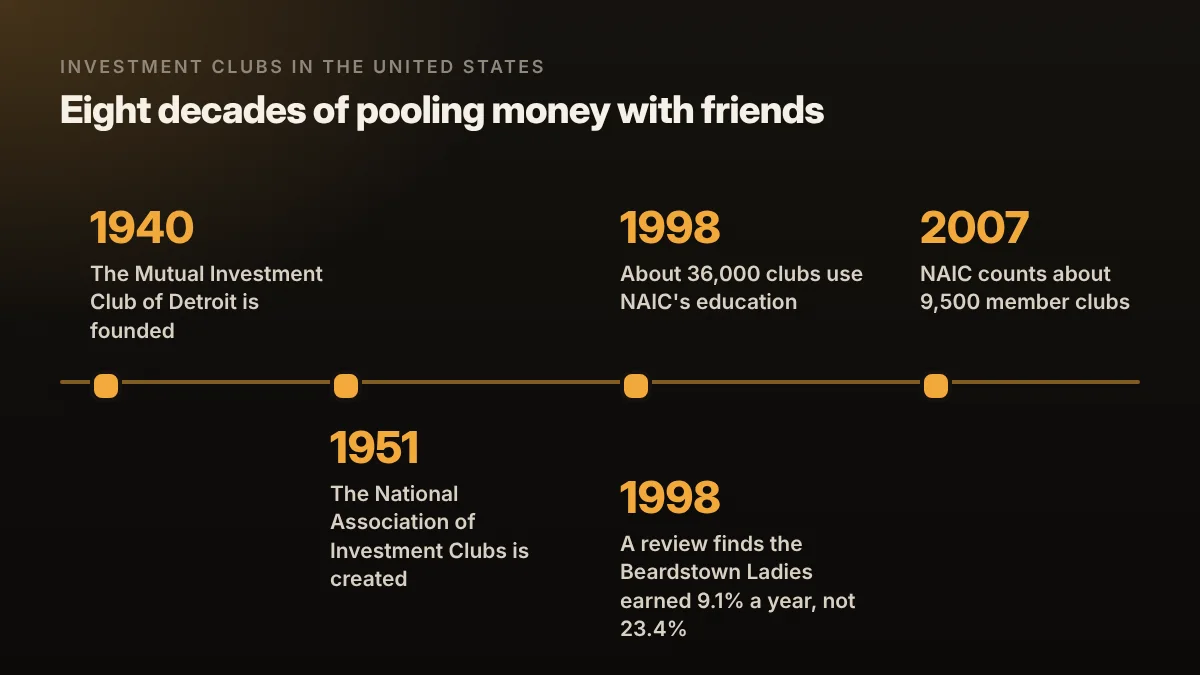
The modern American club movement traces back to Detroit. In 1940, Fred Russell, George Nicholson, and a group of friends formed the Mutual Investment Club of Detroit, and in 1951 Nicholson and Thomas O'Hara created the National Association of Investment Clubs to help other groups copy the model. That organization later became the National Association of Investors Corporation (NAIC) and now does business as BetterInvesting.
| Year | Milestone |
|---|---|
| 1940 | The Mutual Investment Club of Detroit is founded. |
| 1951 | The National Association of Investment Clubs is created, later known as NAIC and then BetterInvesting. |
| 1998 | NAIC reports that it provides education to about 36,000 investment clubs. |
| 1998 | A Price Waterhouse review finds the famous Beardstown Ladies club earned 9.1 percent a year from 1984 to 1993, not the 23.4 percent claimed in its bestselling book. |
| 2007 | NAIC counts about 9,500 member clubs. |
Dates and figures come from BetterInvesting's organizational backgrounder, a May 1998 NAIC press release published by Microsoft, CNNMoney's 1998 report on the Beardstown Ladies, and NAIC figures cited by economic sociologist Brooke Harrington.
Clubs boomed during the bull market of the 1990s, when stock investing became a popular hobby and books about clubs sold well. After the dot-com crash, the number of clubs fell sharply, and it never returned to its late 1990s peak. Cheap online brokerages and index funds have since made it much easier to invest alone.
What are the pros and cons of joining an investment club?
The biggest benefit is education. Having to present a stock to a group forces you to actually read the company's financial statements and explain your reasoning, which is a habit many solo investors never build. Clubs also make it possible to start with small monthly amounts, they spread the research work across several people, and they add a social element that keeps members engaged through boring or scary markets.
The drawbacks are real as well, and they are worth thinking through before anyone puts money into a shared account. A pooled club creates tax filings, record keeping, and legal questions that a solo investor never has to deal with, and the treasurer's job can become a burden. Group decisions can be slow, and a few confident voices can dominate the room. Performance is not guaranteed to be better than investing alone, either. A study by Brad Barber and Terrance Odean, published in the Financial Analysts Journal in 2000, looked at 166 clubs from February 1991 to January 1997 and found that the average club lagged a broad market index and that 60 percent of the clubs underperformed it.
Why do investment clubs fail?
Most clubs that shut down do not collapse because of one bad stock pick. They fade because members stop showing up, stop doing research, or move away, and the work ends up falling on two or three people until they burn out. Disagreements about strategy, such as whether the club should hold stocks for years or trade more often, can also split a group if the partnership agreement never addressed them.
Money and paperwork cause the rest of the trouble. A treasurer who falls behind on unit valuations or misses the Form 1065 deadline can create penalties and hard feelings at the same time. Clubs that do not write clear rules about withdrawals often struggle when a member wants to cash out during a market drop. Groups that last tend to have a detailed partnership agreement, rotating responsibilities, and a simple, repeatable way to share research between meetings so that the monthly vote is not the only time anyone talks about the portfolio.
How can a group chat help an investment club?
Much of a club's real work happens between meetings, when members share links, react to earnings news, and ask each other questions. StockChat is a free iPhone app, currently in beta on TestFlight, that gives a group a private chat built for talking about stocks. When someone mentions a company, a live ticker card shows its current price right in the conversation, and the Analysis feature answers 18 plain-English questions about each stock, such as whether it is beating the S&P 500 and how bad its past drops have been. That gives the member presenting a stock a shared starting point that everyone in the group can look at before the meeting.
Clubs can also ask Max, StockChat's AI analyst, to explain a term or summarize a company in plain language, which is useful for newer members who are still learning. Simulated portfolios, which use paper money rather than real money, let a club test an idea or let prospective members follow along before they commit any cash. None of this replaces the club's brokerage account, partnership agreement, or treasurer, but it can keep the conversation and the research in one place so that the monthly vote is better informed.
Frequently asked questions
Is an investment club legal?
Yes, investment clubs are legal, and the SEC generally does not regulate them. However, a club's membership interests can be treated as securities if some members are passive, so clubs should check federal and state rules and talk to a securities lawyer if they are unsure.
How many members can an investment club have?
There is no single legal size for a club, but the SEC explains that a club relying on an exclusion from the Investment Company Act of 1940 must not have more than 100 members and must not make a public offering. Most clubs are far smaller than that.
Do investment clubs have to file taxes?
A club treated as a partnership files IRS Form 1065 each year and gives every member a Schedule K-1 showing their share of the club's income, gains, and losses. Members then report those amounts on their own returns, so it is wise to have a tax professional review the club's filings.
How much money do you need to join an investment club?
Many clubs let members contribute small monthly amounts, and BetterInvesting's model clubs, for example, set a minimum of $20 a month. Each club sets its own contribution rules in its partnership agreement.
Oscar is the founder of StockChat, where he writes plain-English guides that explain how the market works and where the numbers behind it come from. LinkedIn
This article is educational and is not financial advice.
 What is dividend yield, and when is a high one a warning?
 Most fund managers don't beat the S&P 500
 Is Day Trading Worth It? What the Research Shows