 StockChat
A practical guide
How to start an investment club
An investment club is a group of people who pool money, research and decisions. Starting one is mostly organizational, and the parts that go wrong are usually the parts nobody wrote down. StockChat is a free iPhone group chat built for talking about stocks, with live market data in the thread and a simulated portfolio for each member, which makes it a reasonable place to run a club before any real money is involved.
Free on iPhone. No invite needed. Simulated money, real prices.
The short version
Three things decide whether it lasts.
The right people
Eight to twenty. Pick for whether someone will turn up every month, not for how much they know about markets.
A written agreement
Contributions, how decisions get made, how someone leaves. Settle it while everybody still likes each other.
A meeting rhythm
Same day each month, someone presenting a specific idea and someone else arguing the other side. Clubs die of drifting.
Step by step
The seven steps, in the order they actually happen.
- Find the people first. Eight to twenty is the usual range. Pick for reliability over expertise.
- Agree what the club is for. A club that exists to learn behaves differently from one that exists to make money. Say which one out loud before you take contributions.
- Set the contribution. A fixed monthly amount, the same for everyone, low enough that losing it would annoy rather than hurt.
- Write the agreement. Contributions, decision rules and margins, how someone leaves, what happens to their share. Most clubs run as partnerships, so take legal and tax advice before real money moves.
- Open the accounts. A brokerage account in the club's name and a bank account for contributions. This is where the paperwork lives.
- Set the meeting rhythm. Monthly, same day, with a presenter and a designated skeptic.
- Keep a record of decisions. Not just what you bought, but why, and who argued for it. It is the only way to find out later whether the club is any good at this.
What tends to go wrong
Four failure modes, none of them about stock picking.
- One person does all the work. Rotate who presents.
- Nobody writes down the reasoning. Then every past decision looks obvious in hindsight and the club learns nothing.
- The agreement is vague about leaving. This is the one that ends friendships.
- Meetings become social. Not a disaster, but be honest about which kind of club you are running.
Before the money
Run the first few months on simulated portfolios.
Before anyone contributes real money, give everybody the same $100,000 in simulated money at real prices and let them present ideas in the group chat. After a few months you can see who turns up and whose reasoning holds.
- It costs nothing, so a slow start is not an expensive one.
- It surfaces the people problems early, which are the ones that actually sink clubs.
- The record is kept for you, dated and priced, ready for the first real meeting.
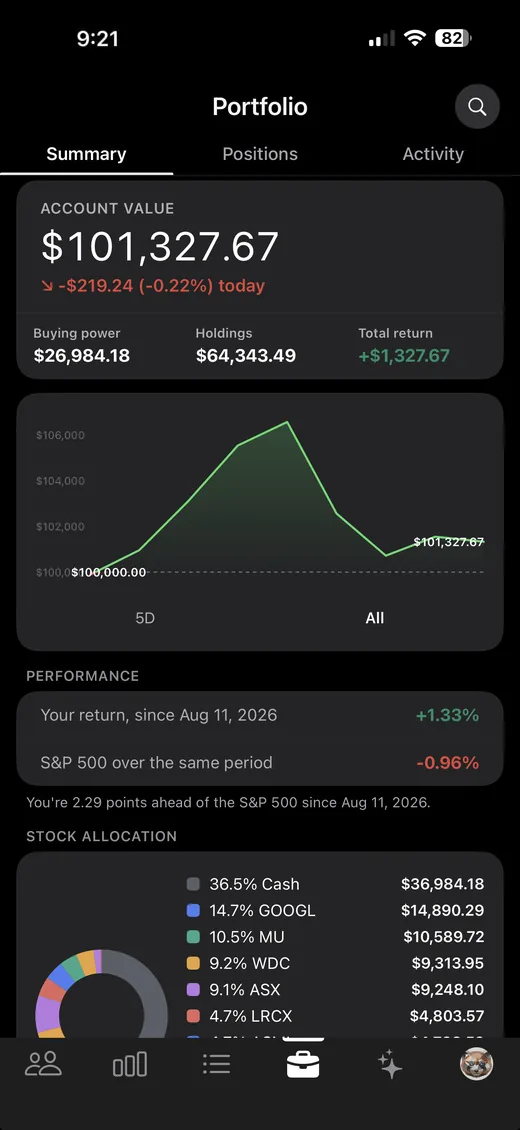
The Summary tab. Illustrative example, simulated money.
The chat
The reasoning sits next to the trade.
Say a ticker with a dollar sign and a live card drops straight into the thread. The call, the argument about it and the price at the time all end up in the same place.
- Type $NVDA and the card appears inline, with the price, the chart and how far it has run since whoever said it first.
- Real bubbles, reactions and replies, so it still feels like the group chat you already have with these people.
- Invite-only, with no public feed and nothing for strangers to discover.
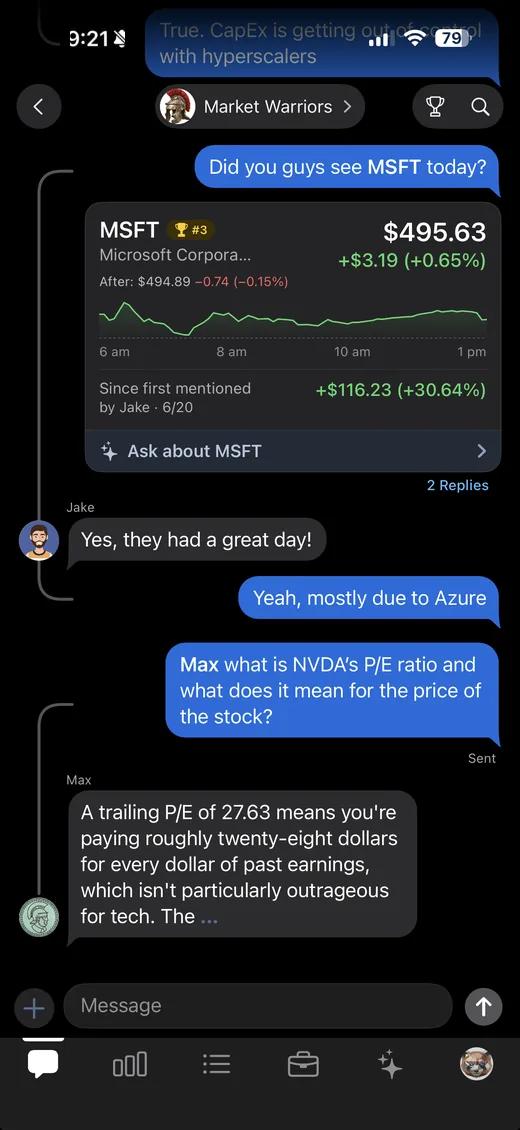
A ticker card inline in the thread.
Where StockChat fits
The conversation, not the accounting.
StockChat gives a club a private group chat where tickers turn into live cards, a shared record of what was discussed and how those tickers moved, and simulated portfolios for each member. It does not do the accounting. Partnership books, member contributions, unit valuations and K-1s all still need a broker and an accountant, and StockChat sits alongside those rather than replacing them.
More on how a club uses the app day to day is on the investment club app page.
This is general information about organizing a club, not legal, tax or investment advice. Rules on club structure and registration vary, so talk to a lawyer and an accountant before pooling real money. The SEC publishes an investor bulletin on investment clubs that is worth reading first.
FAQ
Reasonable questions.
Are investment clubs a good idea?
For learning alongside people you trust, usually yes. As a way to get rich, usually not: a club moves slowly by design and most of the value is in the discussion and the discipline of explaining a decision out loud. Clubs that fail almost always fail on organization, not on stock picking.
How many members should an investment club have?
Most run between 8 and 20. Small enough that everyone gets a turn to present, large enough that contributions add up and a few absences do not cancel the meeting.
Do investment clubs need to register with the SEC?
It depends on how the club is structured and whether membership interests count as securities. Most small clubs where every member participates in decisions do not register, but this is a question for a lawyer rather than for us. The SEC publishes an investor bulletin on clubs.
How much should members contribute?
A common pattern is a modest joining amount and a fixed monthly contribution, set low enough that nobody is stretched. The amount matters less than everybody paying the same and on time.
Do we need a written agreement?
Yes, if real money is involved. It should cover contributions, how decisions are made, how someone leaves and what happens to their share. Clubs usually run as partnerships.
How do you dissolve an investment club?
Follow whatever the agreement says, which is exactly why the agreement needs a leaving clause. In general the club sells its holdings or distributes them in kind, settles costs, pays out each member in proportion to their share, files a final partnership return and closes the accounts. Get an accountant involved before you sell anything, because the tax treatment of selling versus distributing shares is not the same.
Can we start without real money?
Yes, and it is often the sensible order. Running simulated portfolios and a group chat for a few months shows you who actually turns up before anyone writes a check.
Start the club before you fund it.
A group chat and a simulated portfolio each, for as long as it takes to find out whether this group actually enjoys the work.
Join the betaFree · iPhone · no invite needed