 StockChat
What is dividend yield, and when is a high one a warning?
Dividend yield tells you how much cash a stock pays you each year for every dollar you invest. This guide shows how to calculate it with real numbers, what counts as a normal yield, and how Intel's nearly 6% yield turned out to be a warning rather than a bargain.

Dividend yield is the cash a company pays its shareholders over a year, divided by the current share price. Coca-Cola paid $2.10 a share over the past year and closed at $92.71 on October 23, 2026, for a yield of about 2.27%, or roughly $227 a year on $10,000 of stock. Because the price sits in the denominator, a falling share price pushes the yield up, which is why an unusually high yield can be a sign of trouble rather than a bargain.
When you look up a stock in almost any brokerage app, one of the numbers sitting near the price is the dividend yield, usually shown as a small percentage that is easy to skip past. It is worth understanding, because it tells you how much cash a company pays you each year just for owning its shares, and because a yield that looks unusually generous is often telling you something very different from what it appears to say.
What is dividend yield?
A dividend is a cash payment that a company makes to its shareholders, usually out of its profits, and most American companies that pay one do so four times a year. The dividend yield expresses those payments as a percentage of the current share price. In other words, it is the annual dividend per share divided by the price per share, a calculation that makes it possible to compare the income from a $40 stock with the income from a $400 stock on equal terms.
The math is simple enough to do on your phone. Coca-Cola paid $2.10 in dividends per share over the twelve months that ended on October 23, 2026, and its shares closed that day at $92.71, so its yield was $2.10 divided by $92.71, or about 2.27%. In practical terms, if you owned $10,000 of Coca-Cola stock and the company kept paying at that rate, you would collect roughly $227 a year in cash before taxes, whether the share price went up, went down or stayed where it was.
Because the price sits at the bottom of that fraction, the yield moves every time the stock trades. If the price falls and the dividend stays the same, the yield goes up, and if the price rises, the yield goes down. Keeping that one relationship in mind explains almost everything else in this article, including why the highest yields on a screen are often the ones that deserve the most suspicion.
What do real dividend yields look like?
Yields vary enormously from one company to the next, and the differences usually say more about what kind of business a company is than about whether it is a good investment. The table below uses closing prices on October 23, 2026 and the dividends each company paid over the previous twelve months.
| Company | Paid, past year | Price | Yield |
|---|---|---|---|
| Intel (INTC) | $0.00 | $86.96 | 0.00% |
| Apple (AAPL) | $1.06 | $347.73 | 0.30% |
| S&P 500 fund (SPY) | $7.58 | $759.97 | 1.00% |
| Johnson & Johnson (JNJ) | $5.28 | $263.81 | 2.00% |
| Coca-Cola (KO) | $2.10 | $92.71 | 2.27% |
| PepsiCo (PEP) | $5.81 | $135.77 | 4.28% |
| Realty Income (O) | $3.25 | $56.89 | 5.71% |
| Verizon (VZ) | $2.81 | $44.66 | 6.30% |
Prices and dividend payments come from Yahoo Finance daily data, with the yield calculated as the past twelve months of dividends divided by the closing price on October 23, 2026.
Apple is one of the most profitable companies in the world and still yields well under 1%, because it returns most of its spare cash by buying back its own shares rather than by sending checks to shareholders. Verizon and Realty Income sit at the other end of the range, and both belong to industries that tend to pay out a large share of their cash. Realty Income is a real estate investment trust, or REIT, and the SEC's investor bulletin on REITs explains that a company has to distribute at least 90% of its taxable income to shareholders each year to qualify for that status, which is why REIT yields are almost always higher than the market's.
What is a good dividend yield?
There is no single number that counts as good, and anyone who gives you one without asking what kind of company you are looking at is skipping the important part. A useful starting point is the market itself. As the table shows, the S&P 500 as a whole yielded about 1% in October 2026, so a stock yielding 2% to 4% is paying noticeably more than the average large American company, while a stock yielding 7% or 8% is paying several times the market rate.
A yield in that very high range is not automatically a problem, since some businesses, such as utilities, pipelines and REITs, are built to pay out most of what they earn. But when an ordinary company's yield climbs far above its own usual level and far above its industry, the most common explanation is that the share price has fallen because investors expect trouble, and the dividend has not been cut yet. The better question to ask is not whether a yield is high, but whether the company is earning enough cash to keep paying it.
Why is the S&P 500's yield so low today?
It is tempting to read a falling yield as a sign that companies are paying less, but the history of the S&P 500 over the past fifteen years shows the opposite. The dividends paid on each share of the SPY fund roughly tripled between 2011 and 2026, rising from about $2.46 a year to about $7.58, yet the fund's yield fell by about half over the same period, from close to 2% to about 1%.
The explanation is that the price rose even faster than the dividends did. SPY traded around $126 at the end of 2011 and close to $760 in October 2026, an increase of about six times, while the payments only tripled, so each dollar invested now buys a smaller stream of income than it did a decade and a half ago. A low yield in that situation reflects a strong market, not stingy companies.
Dividends have still mattered a great deal over the long run. First Trust, citing Bloomberg data, calculated that dividends accounted for about 36.5% of the S&P 500's total return from the end of 1927 through 2024, which is why long-term comparisons of stock returns should always say whether dividends were included.
What is a dividend yield trap?
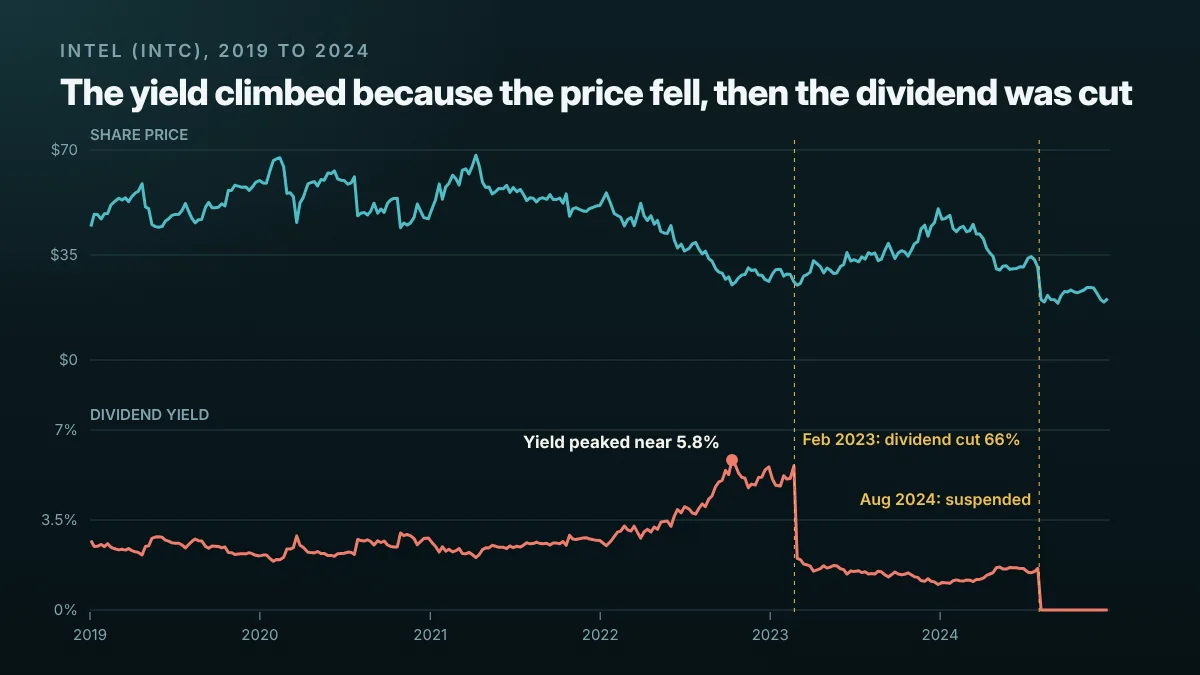
A yield trap is a stock whose yield looks attractive only because its price has collapsed, shortly before the company reduces or eliminates the dividend that made it look attractive in the first place. Intel is one of the clearest recent examples, and the chart at the top of this article follows it from 2019 through 2024.
For years Intel paid a steady and rising dividend, and its yield usually sat between 2% and 3%. As its business struggled in 2022, the share price fell from above $50 to the mid-$20s while the quarterly dividend stayed at 36.5 cents, and the yield climbed to nearly 6%. On February 22, 2023, Intel cut its quarterly dividend to 12.5 cents, a reduction of about 66%, and CNBC reported that the yield dropped from 5.6% to 1.9% on the news. On August 1, 2024, the company went further and, in its second-quarter earnings release, announced that it was suspending the dividend entirely starting in the fourth quarter.
Anyone who bought Intel in late 2022 because of its yield ended up with far less income than the yield promised, along with a share price that swung widely and still ended 2024 below where it stood on the day the cut was announced. The yield on the screen had been accurate about the past twelve months of payments, but it had nothing to say about the next twelve.
Why do different sites show different yields for the same stock?
The yield depends on which dividends you count. A trailing yield adds up what the company actually paid over the past twelve months, which is what the table above uses. A forward yield takes the most recent quarterly payment, multiplies it by four, and divides by today's price, which reacts faster when a company raises or cuts its dividend but assumes the latest payment will continue for a full year. Some sites also use the company's most recent fiscal year, so it is normal to see the same stock listed at slightly different yields depending on where you look.
Realty Income is a good example. Its trailing yield from Yahoo Finance data was 5.71% on October 23, 2026, while StockChat's Analysis feature, which counts dividends over a slightly different window, showed 5.69% based on the same closing price. Small differences like that are expected, but a large gap between the trailing and forward yield is worth investigating, because it usually means the dividend has just been raised or cut.
How does StockChat show a stock's dividend?
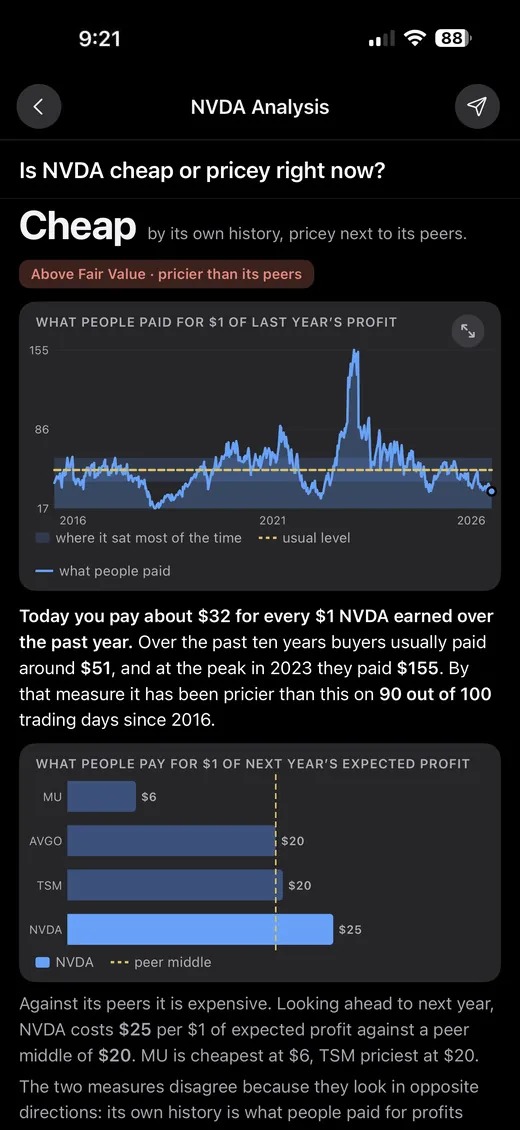
Every stock in StockChat's Analysis feature answers the question "Does it pay dividends?" in plain English, along with how much that dividend would pay on a $10,000 holding. Here is what the app said for three of the companies above, using closing prices from October 23, 2026.
The app showed $1.05 per share a year, or 0.30% of the share price, which works out to about $30 a year on $10,000 of stock. It added that Apple has 33% fewer shares outstanding than nine years ago because it has been buying its own stock back, which raises each remaining holder's share of the profits.
The app showed $3.23 per share a year, or 5.69% of the share price, about $569 a year on $10,000 of stock, and it pointed out that a large yield is sometimes a healthy business sharing its profits and sometimes a falling share price making the old dividend look bigger, so the price over the same years is worth checking.
The app said Intel pays nothing to shareholders, so the only thing owning it returns is what the share price does.
These answers come from StockChat's Analysis feature, calculated from closing prices on October 23, 2026.
StockChat is a private group chat with the research built in. Every stock comes with plain-English answers about its dividend, its valuation, and how far it has fallen in the past, so your group can check whether a high yield is a healthy payout or a warning sign before anyone buys.
Join the free betaWhat else should you know before buying a stock for its dividend?
Timing matters if you want a specific payment. To receive a dividend you need to own the shares before the ex-dividend date, and Investor.gov explains that if you buy on or after that date, the seller gets the payment instead of you. The share price also tends to drop by roughly the amount of the dividend on the ex-dividend date, so buying a stock the day before it goes ex-dividend does not create free money.
Taxes matter too. In a regular brokerage account, the IRS taxes most dividends from American companies that you have held long enough as qualified dividends, at the same lower rates that apply to long-term capital gains, while REIT dividends are generally taxed as ordinary income. Holding dividend stocks in a retirement account can defer those taxes, which is one reason many investors keep their highest-yielding holdings there.
Finally, a dividend is only one part of what a stock returns. A company with a 6% yield whose share price falls 20% has still lost you money, while a company that pays nothing can make you far more if its business grows, so the yield is best treated as one useful number among several rather than the reason to buy on its own.
Frequently asked questions
How do you calculate dividend yield?
Divide the dividends a company paid per share over the past year by the current share price. A stock that paid $2.10 a share and trades at $92.71 yields about 2.27%.
What is a good dividend yield?
There is no single number. The S&P 500 yielded about 1% in October 2026, so 2% to 4% is above average. Yields far above a company's usual level are often a sign the price has fallen because investors expect a cut.
What is a dividend yield trap?
A stock whose yield looks high only because its price collapsed, shortly before the dividend is cut. Intel yielded nearly 6% in late 2022, cut its dividend about 66% in February 2023 and suspended it in August 2024.
Why is the S&P 500 dividend yield so low?
Prices rose faster than dividends. Dividends per SPY share roughly tripled from 2011 to 2026, but the price rose about six times, so the yield fell from about 2% to about 1%.
Oscar is the founder of StockChat, where he writes plain-English guides that explain how the market works and where the numbers behind it come from. LinkedIn
This article is educational and is not financial advice.
 Most fund managers don't beat the S&P 500
 What Is an Investment Club and How Does One Work?
 Is Day Trading Worth It? What the Research Shows