 StockChat
Is Day Trading Worth It? What the Research Shows
Day trading looks simple on a screen, but decades of trading records from Taiwan, Brazil and the U.S. tell a much more sobering story about who makes money.

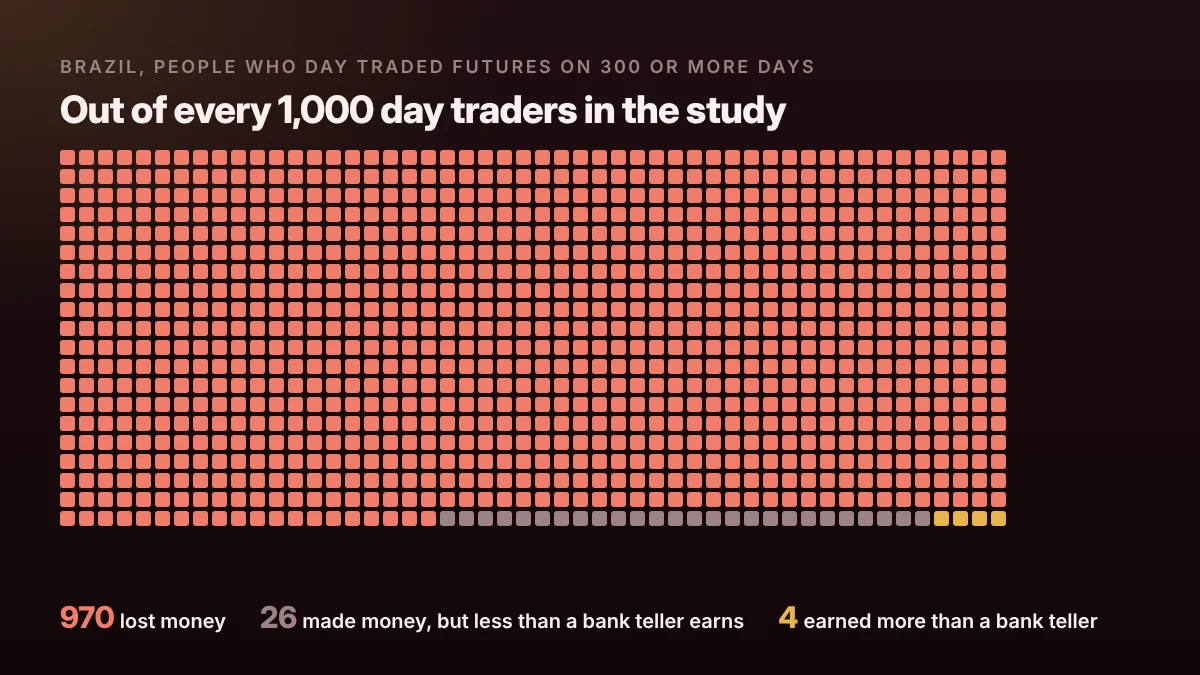
For most people the evidence says no, because large studies of real trading records found that less than 1% of day traders in Taiwan were reliably profitable after fees and 97% of Brazilians who day traded futures for at least 300 days lost money. Spreads, short-term capital gains taxes and the emotional pull of frequent trading make it even harder to come out ahead. The U.S. pattern day trader rule and its $25,000 minimum were replaced in 2026, which makes day trading easier to start but does not change those odds.
What is day trading?
Day trading means buying and selling the same stock, option, or futures contract within a single trading day, so that the trader ends the day holding few or no open positions. The goal is to profit from small price moves that happen over minutes or hours rather than from a company growing in value over years. The SEC describes day traders as people who "rapidly buy and sell stocks throughout the day" in the hope that prices keep moving in their favor long enough to lock in a gain, and it notes that many of them use borrowed money to do it.
That last point matters, because a lot of day trading happens in a margin account, which is a brokerage account that lets you borrow from the broker to buy more than your cash alone would allow. Borrowing magnifies both gains and losses, and the SEC's investor alert on day trading puts it bluntly when it tells people to "be prepared to suffer severe financial losses." It also calls day trading "an extremely stressful and expensive full-time job."
Day trading is different from investing, where a person buys shares and holds them for months or years, and it is also different from swing trading, where positions are held for several days or weeks. The question of whether day trading is worth it comes down to whether the average person can earn enough from those small intraday moves to cover costs, taxes, and the occasional large loss.
What was the pattern day trader rule, and has it changed?
For more than two decades, U.S. brokers followed FINRA's pattern day trader rule. FINRA (the Financial Industry Regulatory Authority) is the self-regulatory organization that writes rules for brokerage firms under SEC oversight. Under that rule, a customer was labeled a pattern day trader if they made four or more day trades within five business days in a margin account, as long as those day trades were more than 6% of the customer's total trades in that period. Once labeled, the customer had to keep at least $25,000 in equity in the account to keep day trading, and accounts below that level were restricted.
That rule, however, has now been replaced, which will surprise anyone who learned about day trading more than a year or two ago. FINRA filed a proposal in 2025 to swap the day trading provisions of its margin rule (Rule 4210) for new intraday margin standards, and the SEC approved the change on April 14, 2026. FINRA's Regulatory Notice 26-10 set the effective date as June 4, 2026, and it gave brokerage firms until October 20, 2027 to finish implementing it. Under the new approach there is no pattern day trader label based on trade counts and no $25,000 minimum. Instead, firms check whether a margin account has enough equity during the day to support its open positions, and a shortfall creates an "intraday margin deficit" that the customer must cover as promptly as possible. Customers who repeatedly fail to cover those deficits can have their accounts restricted for up to 90 days.
There are two details in the new arrangement that are easy to miss if you only read the headlines. First, the long-standing $2,000 minimum equity needed to borrow on margin did not go away. Second, FINRA says a firm may keep applying the old day trading rules until it switches to the new system, so as of October 2026 some brokers may still enforce the $25,000 requirement. If you want to know which rules apply to your account, your broker is the only one who can tell you.
What did large studies find about day traders' results?
The most detailed research on day traders comes from Taiwan, where economists Brad Barber, Yi-Tsung Lee, Yu-Jane Liu and Terrance Odean were given complete trading records for the Taiwan Stock Exchange from 1992 to 2006. In a typical month during that period almost 140,000 individuals day traded, which makes it one of the largest samples of its kind. In a 2014 paper in the Journal of Financial Markets, they reported that less than 1% of the day trader population was able to predictably and reliably earn positive returns after fees. A related working paper by the same group found that more than 75% of day traders quit within two years, and that most of the trading volume came from traders who were losing money.
A second well-known study looked at Brazil. Fernando Chague, Rodrigo De-Losso and Bruno Giovannetti studied every individual who started day trading mini-index futures on the Brazilian exchange between 2013 and 2015 and kept at it for at least 300 days, which filters out people who tried it briefly and quit. Among those persistent traders, 97% lost money. Only 0.4% earned more than the starting pay of a bank teller, which the authors put at about US$54 per day, and the single best performer earned about US$310 per day with enormous swings from day to day. The authors also found no evidence that traders got better with experience, and they concluded that it is "virtually impossible" for an individual to day trade for a living.
| Study | Market and period | Key finding |
|---|---|---|
| Barber, Lee, Liu and Odean (2014) | Taiwan stocks, 1992 to 2006 | Less than 1% of day traders predictably earned positive returns after fees |
| Barber, Lee, Liu, Odean and Zhang (working paper, 2017) | Taiwan stocks, 1992 to 2006 | More than 75% of day traders quit within two years |
| Chague, De-Losso and Giovannetti (2020) | Brazil index futures, 2013 to 2015 starters | 97% of those who day traded 300+ days lost money, and 0.4% earned more than a bank teller |
| Barber and Odean (2000) | 66,465 U.S. households, 1991 to 1996 | The most active traders earned about 11.4% a year while the market returned about 17.9% |
These figures come from the published papers and working papers listed in the sources section, and the full papers explain how each group of researchers measured returns and costs.
None of these studies says that nobody can make money day trading, and the Taiwan research did find a small group of consistently skilled traders. What they show is that the odds for a typical person are poor, that skill is rare and hard to identify from the inside, and that losing traders often keep going long after the numbers have turned against them.
What does day trading actually cost?
The first cost is one most beginners never see on a statement. Every stock has a bid, which is the highest price a buyer is offering, and an ask, which is the lowest price a seller will accept, and the gap between them is called the spread. When you buy at the ask and sell at the bid, you give up the spread on every round trip. A day trader who makes dozens of trades a week pays it over and over, and on thinly traded stocks the spread can erase a small gain before the trade even starts. Commissions have fallen to zero at many U.S. brokers, but fees still apply to some products such as options and futures, and borrowing on margin carries interest.
Taxes are the second cost, and they tend to catch people off guard more than the trading costs do. The IRS treats a gain on anything held one year or less as a short-term capital gain, and net short-term gains are taxed as ordinary income at the same graduated rates as wages, rather than at the lower long-term rates. On the other side, if your losses exceed your gains for the year, you can deduct only up to $3,000 of the net loss against other income ($1,500 if married filing separately) and must carry the rest forward to future years.
The third cost is the wash sale rule, which catches many active traders off guard. If you sell a stock at a loss and buy the same or a substantially identical security within 30 days before or after that sale, the IRS does not let you deduct the loss at that time. Instead the disallowed loss is added to the cost basis of the replacement shares. A trader who keeps selling and rebuying the same ticker can end the year with losses that cannot be claimed yet. Because tax situations vary, a qualified tax professional is the right person to explain how these rules apply to a specific person.
Why is the psychology of day trading so hard?
Barber and Odean's study of more than 66,000 U.S. brokerage households found that the people who traded the most earned noticeably less than the market, and the authors argued that overconfidence, meaning a tendency to overrate one's own skill and information, explains much of that excess trading. Day trading tends to amplify the feeling, because a few early wins can feel like proof of talent even when they were mostly luck. The Taiwan data fit that story, since many unprofitable traders kept trading for years after the evidence was clear.
There are other pressures as well, and most of them have more to do with how people behave than with the market itself. Watching money rise and fall by the minute triggers strong emotions, and decisions made in that state tend to be rushed. Many traders find it hard to close a losing position because selling makes the loss feel real, and they find it easy to take a small profit too early because it feels good to lock something in, which is exactly the opposite of what a working strategy usually needs.
Is there a safer way to learn how trading works?
One common approach is paper trading, which means placing simulated trades with pretend money while tracking results as if they were real. It will not reproduce the stomach-churning feeling of losing actual dollars, but it does let you test whether a strategy holds up across a few hundred trades, see how often your stop losses would have been triggered, and learn how quickly small costs add up. StockChat, a free iPhone app currently in beta on TestFlight, includes simulated portfolios for this purpose, along with an Analysis feature that answers questions such as "How big are its ups and downs?", "Would a stop loss have helped?" and "How bad have the drops been?" in plain English.
The other thing that helps is talking trades over with people you trust before you make them. Explaining why you want to buy something, and hearing a friend ask why you are so sure, is a simple way to catch overconfidence early. StockChat was built around that idea as a private group chat for talking about stocks, with live ticker cards that show the stock being discussed and an AI analyst called Max that can answer research questions in the conversation. Whatever tools you use, practicing with simulated money and getting a second opinion costs nothing and can reveal a lot about how you behave when the market moves.
So, is day trading worth it?
Based on the largest studies available, day trading is a losing activity for the overwhelming majority of the people who try it, and that holds true across very different markets and decades. The end of the $25,000 pattern day trader rule makes it easier for people with smaller accounts to day trade on margin, but it does not change the underlying math of spreads, taxes, and human behavior that the research describes. Whether it is worth it for any one person is a personal decision, and the clearest thing the evidence offers is a realistic picture of the odds before real money is on the line.
Frequently asked questions
What is day trading?
Day trading is buying and selling the same stock, option or futures contract within a single trading day in order to profit from short-term price moves. Day traders usually close their positions before the market closes, and many of them use borrowed money in a margin account.
Do you still need $25,000 to day trade in the U.S.?
FINRA replaced the pattern day trader rule and its $25,000 minimum with new intraday margin standards that took effect on June 4, 2026. Brokers have until October 20, 2027 to switch over and may keep applying the old rule until they do, so your broker can tell you which rules apply to your account.
What percentage of day traders lose money?
A study of people in Brazil who day traded index futures for at least 300 days found that 97% of them lost money. Research on Taiwan's stock market from 1992 to 2006 found that less than 1% of day traders could predictably earn positive returns after fees.
How are day trading profits taxed?
The IRS treats gains on positions held one year or less as short-term capital gains, which are taxed as ordinary income at the same rates as wages. The wash sale rule can also delay deducting a loss if you buy the same or a substantially identical security within 30 days before or after selling it at a loss.
Oscar is the founder of StockChat, where he writes plain-English guides that explain how the market works and where the numbers behind it come from. LinkedIn
This article is educational and is not financial advice.
 Most fund managers don't beat the S&P 500
 What is dividend yield, and when is a high one a warning?
 What Is an Investment Club and How Does One Work?