 StockChat
Limit Order vs. Market Order: What's the Difference?
A plain-English guide to the two most common order types, the market mechanics behind them, and what regulators learned when market orders went badly wrong.

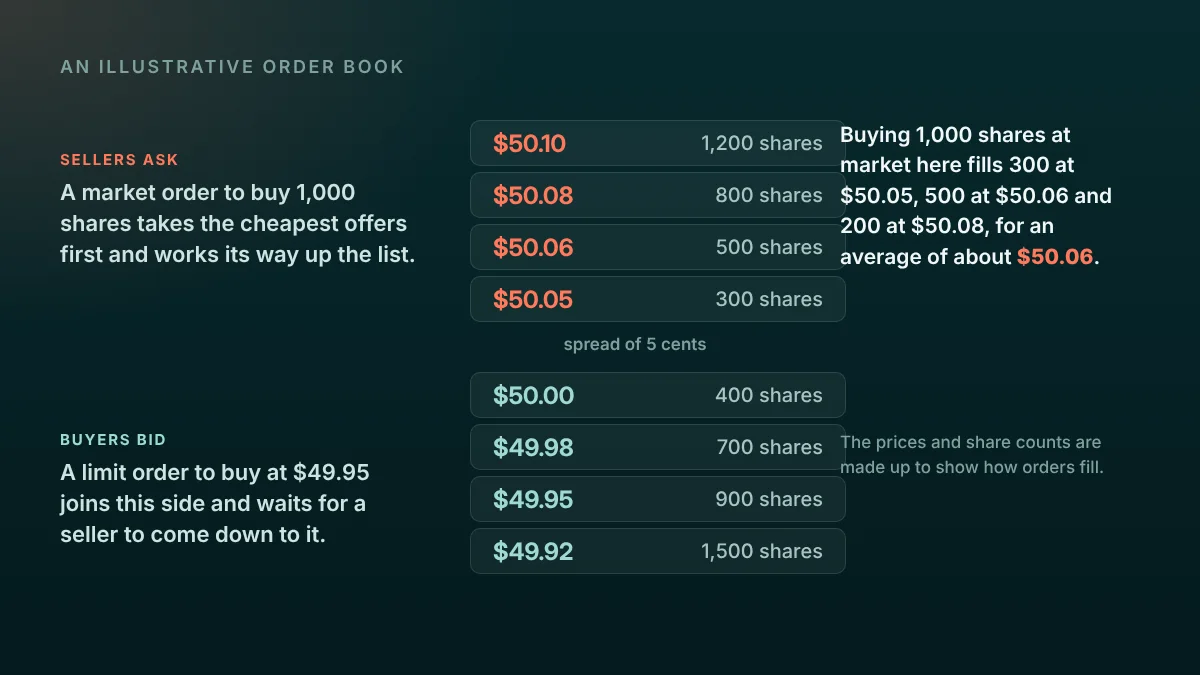
A market order buys or sells a stock right away at the best price available, so it almost always fills but the price is not guaranteed. A limit order buys or sells only at a price you choose or better, so the price is protected but the order may fill only partly or not at all.
Every time you buy or sell a stock through a broker, you send an instruction called an order, and the type of order you pick decides what you are willing to give up. Most of the time the difference between a market order and a limit order is a few cents, but in a few well-documented moments in market history it has been the difference between a normal trade and a very bad one. This guide explains how each order works, the market mechanics behind them, and what regulators found when things went wrong.
What is a market order?
A market order is an instruction to buy or sell a stock immediately at the best price currently available. The SEC's investor education site, Investor.gov, explains that a market order generally executes at or near the current ask price if you are buying and at or near the current bid price if you are selling. FINRA, the organization that oversees broker-dealers in the United States, describes it as the order type that gives you the most certainty that your order will be executed.
The catch is that a market order makes no promise about price. FINRA warns that you might not get the price you saw or were originally quoted, especially in fast-moving markets. When you send a market order, you are really saying that you want the shares now and will accept whatever the market charges in that moment.
What is a limit order?
A limit order is an instruction to buy or sell a stock at a specific price or better. A buy limit order at $50 can only be filled at $50 or lower, and a sell limit order at $50 can only be filled at $50 or higher. The price you set is called the limit price.
FINRA puts the tradeoff simply: you are guaranteed your limit price or a better one if the order is executed, but there is a chance it will not be executed at all. If the stock never trades at your price, or other orders at that price are ahead of yours, your order sits unfilled. In short, a market order guarantees execution but not price, and a limit order guarantees price but not execution.
How does the bid-ask spread affect your price?
Investor.gov defines the bid price as the highest price a buyer is willing to pay for a stock at a given moment, and the ask price as the lowest price at which a seller is willing to sell. The gap between the two is called the bid-ask spread, or simply the spread.
Imagine, purely as an illustration, a stock with a bid of $50.00 and an ask of $50.05. A market order to buy would typically fill near $50.05, because that is what the cheapest seller is asking, while a market order to sell would typically fill near $50.00. That five cent spread is the price of immediacy. In thinly traded stocks, during volatile periods, and outside regular trading hours, the spread can be much wider, which makes the result of a market order harder to predict.
What is slippage, and why does it get worse in fast markets?
Slippage is the difference between the price you expected when you placed an order and the price you actually received. The quote on your screen is a snapshot, and by the time your order arrives the best price may have moved. Each quoted price also covers only a limited number of shares, and Investor.gov notes that parts of a large market order may execute at different prices when there is not enough liquidity, meaning willing buyers or sellers, at a single price.
Slippage tends to grow when prices move quickly, such as after a surprise earnings report, because quotes change faster and fewer shares are offered at each price. The open deserves special mention, since overnight news gets priced in all at once when regular trading begins at 9:30 a.m. Eastern Time. FINRA cautions that news events can significantly affect a stock's price when the market opens again, so a market order placed the night before will execute into whatever conditions exist at the open.
What is a partial fill?
A partial fill happens when only some of the shares in your order are executed. FINRA explains that, unless you give special instructions, a firm might buy or sell only the portion of your order that is available. This is most common with limit orders, because there may be only a few hundred shares available at your price when you wanted a thousand, and the rest of the order stays open until it fills, is canceled, or expires. Some brokers offer instructions such as all-or-none or fill-or-kill for investors who want the whole order filled or nothing at all.
How long does an order stay open?
How long an order remains active is called its time in force. A day order, as FINRA describes it, stays active only through the current trading session, so an unfilled day limit order expires at the close. A good-til-canceled order, often shortened to GTC, lasts until it is executed in full or you cancel it, according to Investor.gov. FINRA adds that brokerage firms typically cap how long these orders can stay active, often at many months, so a GTC order you forgot about could still be working long after you stopped watching the stock.
Where do stop and stop-limit orders fit in?
A stop order, sometimes called a stop-loss order, is an order to buy or sell a stock once it reaches a specified price, known as the stop price. Investor.gov explains that when the stop price is reached, a stop order becomes a market order, and that the stop price is not a guaranteed execution price. In a fast decline, a sell stop set at $45 could be triggered at $45 and fill noticeably lower.
A stop-limit order becomes a limit order once the stop price is reached, so it will only execute at the limit price or better. That protects you from a terrible fill, but as FINRA points out, there is no guarantee it will execute at all. Investor.gov also notes that both types can be triggered by a short-term, intraday price move that quickly reverses.
How do the main order types compare?
| Order type | What it does | Guarantees execution? | Guarantees price? | Main risk |
|---|---|---|---|---|
| Market | Buys or sells right away at the best available price | Generally yes | No | A worse price than expected |
| Limit | Buys or sells only at your price or better | No | Yes, if it fills | Never filling, or filling partly |
| Stop | Becomes a market order at the stop price | Generally yes, once triggered | No | Filling well past the stop price |
| Stop-limit | Becomes a limit order at the stop price | No | Yes, if it fills | Triggering and then not filling |
This table summarizes order type descriptions published by the SEC on Investor.gov and by FINRA.
Why do many brokers accept only limit orders outside regular hours?
Regular trading on U.S. stock exchanges runs from 9:30 a.m. to 4:00 p.m. Eastern Time, but many brokers also offer pre-market and after-hours sessions, together known as extended-hours trading. The SEC's investor bulletin on the subject notes that many brokerage firms accept only limit orders during these sessions, although policies vary by firm.
The reason is that these sessions tend to be thin. The SEC explains that there is generally less trading interest and therefore less price competition outside regular hours, which usually means wider spreads and larger price swings, and some stocks may not trade at all. In that setting a market order could fill far from the last regular-session price, while a limit order sets a ceiling or floor on what you will accept.
What did the 2010 Flash Crash show about market orders?
On the afternoon of May 6, 2010, the Dow Jones Industrial Average was already down about 2.5 percent by 2:30 p.m. when the major U.S. stock indexes suddenly fell a further 5 to 6 percent within minutes and then recovered almost as quickly. In a joint report released on October 1, 2010, the staffs of the SEC and the Commodity Futures Trading Commission found that between 2:40 p.m. and 3:00 p.m., more than 20,000 trades in more than 300 securities were executed at prices 60 percent or more away from their 2:40 p.m. prices, some as low as a penny and others as high as $100,000.
The report explained that participants who sent orders to buy or sell at the market found no immediately available interest on the other side, so their orders executed against whatever was left, including stub quotes, which are placeholder quotes set far from the real price. Many retail stop-loss orders, triggered by falling prices, added to the selling. After the close, the exchanges and FINRA agreed to cancel trades more than 60 percent away from the reference price, which meant badly priced trades that fell short of that threshold stood.
What happened at the open on August 24, 2015?
A second episode came on Monday, August 24, 2015, when U.S. markets opened sharply lower. According to a research note published by SEC staff in December 2015, the SPDR S&P 500 ETF (SPY) opened 5.2 percent below its prior close and was down as much as 7.8 percent by 9:35 a.m. Trading was paused 1,278 times across 471 securities under the Limit Up Limit Down mechanism, which briefly halts trading when prices move outside set bands, and 1,058 of those pauses were in exchange-traded products such as ETFs.
The SEC staff found that 19.2 percent of exchange-traded products declined by 20 percent or more that day, compared with 4.7 percent of corporate stocks. The iShares Core S&P 500 ETF (IVV), which tracks the same index as SPY, fell more than 20 percent below its previous close and traded at a large discount to SPY until about 9:43 a.m. The note also found that market orders made up 94 percent of total sell imbalances in the reopening auctions on NYSE Arca.
How can you practice order types without real money?
Reading about order types helps, but watching prices move is what makes the differences stick. A simulated portfolio, sometimes called paper trading, lets you practice buying and selling without risking real money, so you can get a feel for how far prices travel between the moment you decide to trade and the moment a trade would happen. StockChat, a free iPhone app currently in beta, includes simulated portfolios for this kind of practice. It is not a broker and does not place real trades.
It also helps to know what a stock is doing before the open or after the close, when spreads tend to widen and prices can drift from the last close. StockChat's ticker cards show the current price, the day's change, and the pre-market or after-hours price, which gives a group chat a shared reference point when someone asks why a stock moved overnight, and the app's Analysis feature and its AI analyst, Max, offer plain-English context about the company itself.
Frequently asked questions
What is a limit order?
A limit order is an instruction to buy or sell a stock at a specific price or better. A buy limit order can only fill at or below your limit price, and a sell limit order can only fill at or above it, but there is no guarantee the order will be filled.
Is a market order or a limit order better?
Neither is better in every situation, because each makes a different tradeoff. A market order puts certainty of execution first, while a limit order puts control over price first, and the risks of market orders are greater when spreads are wide or prices are moving quickly.
Can I use a market order before the market opens or after it closes?
It depends on your broker, but the SEC notes that many brokerage firms accept only limit orders during extended-hours sessions. Trading outside regular hours generally has less trading interest and wider spreads, which is a large part of the reason.
Why did my limit order fill only partly?
A limit order can be partly filled when fewer shares are available at your price than you asked for. Unless you added an instruction such as all-or-none, the remaining shares usually stay open until they fill, you cancel them, or the order expires.
Oscar is the founder of StockChat, where he writes plain-English guides that explain how the market works and where the numbers behind it come from. LinkedIn
This article is educational and is not financial advice.
 What is dividend yield, and when is a high one a warning?
 Most fund managers don't beat the S&P 500
 What Is an Investment Club and How Does One Work?