 StockChat
What is a stock split, and does it make a stock cheaper?
A stock split cuts the same company into more, smaller pieces. This guide walks through Nvidia's 10-for-1 split share by share, shows how nine recent splits played out, and explains why a reverse split is a different story.

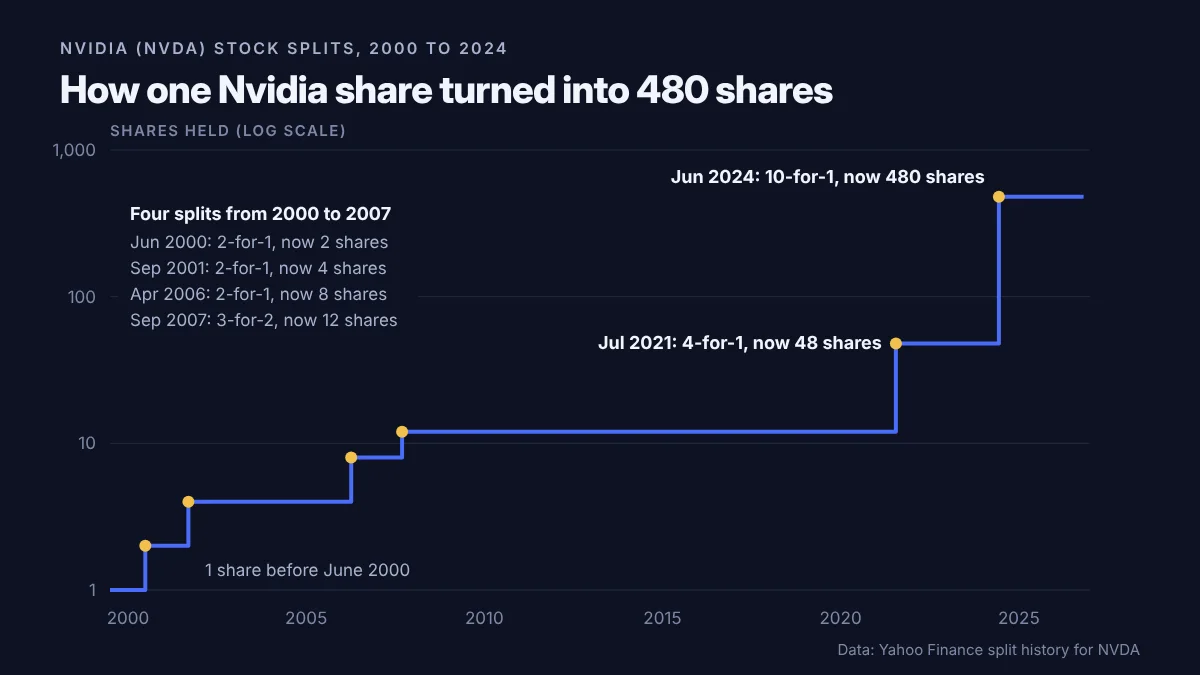
A stock split gives every shareholder more shares at a proportionally lower price, so the total value of what you own stays the same. When Nvidia split 10-for-1 in June 2024, 10 shares at $1,208.88 became 100 shares that closed at $121.79 the next trading day. A split does not make the company any cheaper, and a reverse split, which combines shares into fewer, pricier ones, is often a sign of a struggling stock.
Every few months a familiar headline comes around: a company with a share price in the hundreds or thousands of dollars announces a stock split, and its stock suddenly looks far cheaper the following week. Nvidia did it in 2024, when a share that closed at $1,208.88 on a Friday traded the following Monday at about a tenth of that price. Nothing about the company had changed over the weekend, and understanding why is the key to understanding what a split does and what it does not do.
What is a stock split?
A stock split is a decision by a company's board to increase the number of shares it has outstanding, which is the total number of shares owned by all of its investors, by giving every existing shareholder extra shares in a fixed proportion. In a 2-for-1 split, each share you own becomes two shares, and in a 10-for-1 split each share becomes ten. Because the company itself is worth exactly the same before and after, the price of each share falls in the same proportion, so the total value of what you own does not move.
FINRA's guide to stock splits uses a simple example: if you own 10 shares worth $100 each and the company splits 2-for-1, you end up with 20 shares worth about $50 each, and your holding is still worth $1,000. FINRA also points out that the company's market capitalization, meaning the total value of all its shares added together, stays the same, which is why a split does nothing to change what a business is worth. A good way to picture it is cutting a pizza into sixteen slices instead of eight, since you have more pieces but exactly the same amount of pizza.
What happened to Nvidia's shareholders in 2024?
Nvidia's 10-for-1 split is a clean real example. In the earnings release it filed with the SEC on May 22, 2024, the company said shareholders of record at the close on June 6 would receive nine additional shares for every share they held after the close on June 7, and that the stock would begin trading on a split-adjusted basis when the market opened on Monday, June 10.
Yahoo Finance's daily prices show what that looked like. Nvidia closed at $1,208.88 on June 7, 2024, so someone with 10 shares held about $12,089 of stock. On June 10 that same person had 100 shares, and the stock closed at $121.79, so the holding was worth about $12,179. The small difference is simply what the stock did that Monday, not anything the split created. The dividend was divided up the same way: Nvidia raised its quarterly dividend to $0.10 per share before the split, which the company noted would equal $0.01 per share afterward.
The chart below shows the same three months two ways. The yellow line is the price as it was actually quoted each day, which falls off a cliff on June 10, and the blue line is the split-adjusted price, which divides every pre-split price by ten so the history can be compared on equal terms.
Daily closing prices come from Yahoo Finance. After June 10 the two lines are the same, so only the blue line is visible.
Why do companies split their stock?
The reason companies give most often is that a lower share price makes it easier for ordinary people to buy whole shares. Nvidia said its split was meant to "make stock ownership more accessible to employees and investors." Walmart said much the same thing when it announced a 3-for-1 split in January 2024, its first since 1999 according to its split history on Yahoo Finance. The company tied the decision to its desire for employees "to feel that purchasing shares is easily within reach," and noted that more than 400,000 of its roughly 2.1 million employees buy stock through its payroll purchase plan, with Walmart matching 15% of the first $1,800 they put in each year.
There is also a psychological side. FINRA notes that a very high stock price can intimidate investors who feel there is little room left for it to rise, even though a $1,000 share and a $100 share of the same company have exactly the same room to grow in percentage terms.
Splits can also matter for stock indexes that are weighted by share price rather than by company size. The Dow Jones Industrial Average is one of them, which means a stock with a $500 price counts for far more in the average than a stock with a $50 price. When Apple split its shares 4-for-1 in August 2020, S&P Dow Jones Indices said the split would reduce the index's weight in technology stocks, and it added Salesforce, Amgen and Honeywell, replacing Exxon Mobil, Pfizer and Raytheon Technologies, on the same day the split took effect.
What do recent big splits look like?
The largest American companies have split their shares many times. Some of the best-known splits of the past few years are below, with the last closing price before the split and the first closing price after it. In every case the drop in price reflects the split ratio, plus or minus whatever the stock happened to do on its first split-adjusted day.
| Split | Close before | Close after |
|---|---|---|
| Apple 4-for-1, Aug 2020 | $499.23 | $129.04 |
| Tesla 5-for-1, Aug 2020 | $2,213.40 | $498.32 |
| Nvidia 4-for-1, Jul 2021 | $751.19 | $186.12 |
| Amazon 20-for-1, Jun 2022 | $2,447.00 | $124.79 |
| Alphabet 20-for-1, Jul 2022 | $2,235.55 | $109.03 |
| Tesla 3-for-1, Aug 2022 | $891.29 | $296.07 |
| Walmart 3-for-1, Feb 2024 | $175.56 | $59.60 |
| Nvidia 10-for-1, Jun 2024 | $1,208.88 | $121.79 |
| Chipotle 50-for-1, Jun 2024 | $3,283.04 | $65.86 |
Split dates, ratios and closing prices come from Yahoo Finance daily data, with prices shown as they were quoted at the time.
Over long periods these splits stack on top of each other, which is how a single share bought decades ago turns into hundreds. Nvidia has split six times since 2000, so one share held before its June 2000 split is 480 shares today. That one share closed at $165.94 on June 26, 2000, and the 480 shares it became were worth about $103,680 at the October 26, 2026 close of $216.00, before counting any dividends. Apple has split five times since 1987, so one share that closed at $78.50 on June 15, 1987 is now 224 shares, worth about $77,036 at $343.91. Walmart has split ten times since 1975, turning one share that closed at $23.00 on August 22, 1975 into 1,536 shares, worth about $184,765 at $120.29. None of those gains came from the splits themselves, since the splits only changed how many slices the same growing company was cut into.
Do stocks go up after a split?
This is where it gets interesting, because a split should not matter, yet researchers have found that splitting companies often did well afterward. The best-known study, "What Do Stock Splits Really Signal?" by David Ikenberry, Graeme Rankine and Earl Stice, published in 1996 in the Journal of Financial and Quantitative Analysis, looked at 1,275 two-for-one splits and found the stocks beat comparable shares by 7.93% in the first year and by about 12% over three years. The authors' reading was that managers tend to split when they are confident about the company's future, and that the market is slow to take that signal fully on board.
That does not mean a split is a buy signal you can count on, and the recent splits in the table show why. The table below compares each stock's price change over the following year, measured over 252 trading days from its last pre-split close, with the S&P 500 fund SPY over the same days. Four of the nine beat the fund and five trailed it, and Chipotle fell 14.5% in a year when the fund rose 13.4%.
| Split | Stock, next year | SPY, same days |
|---|---|---|
| Apple, Aug 2020 | +21.7% | +28.8% |
| Tesla, Aug 2020 | +66.2% | +28.8% |
| Nvidia, Jul 2021 | −5.2% | −7.1% |
| Amazon, Jun 2022 | −0.9% | +3.9% |
| Alphabet, Jul 2022 | +9.2% | +18.2% |
| Tesla, Aug 2022 | −19.6% | +7.0% |
| Walmart, Feb 2024 | +65.4% | +15.2% |
| Nvidia, Jun 2024 | +19.9% | +13.1% |
| Chipotle, Jun 2024 | −14.5% | +13.4% |
Price changes are calculated from Yahoo Finance daily closing prices, adjusted for splits and not including dividends.
What is a reverse stock split?
A reverse stock split works the other way around, combining several shares into one so that there are fewer shares and each one costs more. FINRA's example is an investor with 5,000 shares at $0.10 each, worth $500, who ends up with 25 shares at $20 each after a 1-for-200 reverse split, still worth $500. FINRA explains that small companies sometimes do this because they think their price is too low to attract investors, or because an exchange requires a minimum share price to stay listed, and it advises investors to "proceed with caution," noting that reverse splits "tend to go hand in hand with low-priced, high-risk stocks."
Large companies do it too, usually after shrinking. General Electric carried out a 1-for-8 reverse split in 2021, and in its announcement the company said it had sold off many businesses without reducing its share count, so the split would cut its roughly 8.8 billion shares to about 1.1 billion and "better align GE's number of shares outstanding with companies of our size and scope." GE closed at $12.95 on July 30, 2021 and at $100.60 on August 2, its first day on the new basis, close to the eight times you would expect. GE also said it would not issue fractional shares, so a shareholder whose count did not divide evenly by eight received cash for the leftover fraction.
Why don't old price charts show the drop?
If you pull up a long-term chart of Nvidia in most apps, you will not see a 90% crash in June 2024, because the chart has been split-adjusted, with every price before the split divided by the split ratio. Without that adjustment, every split would look like a collapse and every long-term return calculation would be wrong. It also matters for any number that compares the price with per-share figures, such as earnings per share, because those per-share figures are restated after a split too.
This is also why the old price you remember can look strange today. Apple's $499.23 close in August 2020 shows up as roughly $125 on an adjusted chart, and neither number is wrong. They simply describe the same moment using two different share counts.
How does StockChat handle splits?
StockChat is a private group chat with the research built in, and the price history behind its Analysis answers is split-adjusted, so a split never shows up as a crash and a long-run figure such as what buyers usually paid for $1 of a company's profit is measured on the same share count from start to finish. That matters more than it sounds. When we built the feature, leaving Nvidia's prices unadjusted against its split-adjusted earnings gave it a ten-year median price-to-earnings ratio of 889, when the real figure was about 51.
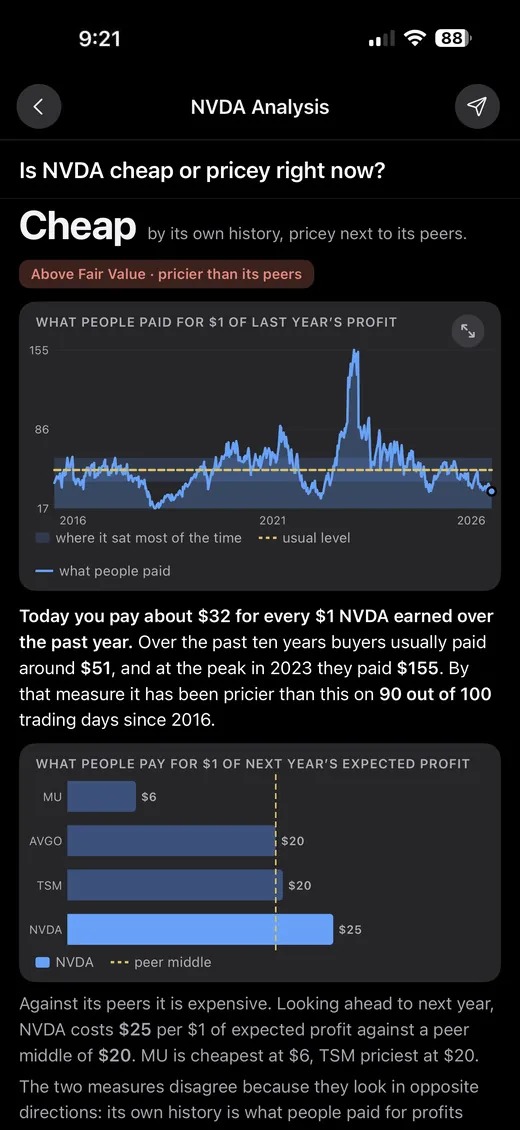
When someone in your group says a stock got cheaper after its split, everyone can open the same plain-English answer and see whether the business got cheaper too, or only the shares.
Join the free betaWhat happens to your shares on split day?
If you own a stock that splits, you do not have to do anything. Your broker adds the new shares to your account automatically, usually by the morning the stock starts trading on its new basis, and your cost basis, which is the price you paid for tax purposes, is spread across the larger number of shares so the total stays the same.
The dates in a split announcement work much like dividend dates. The record date decides who receives the new shares, the distribution date is when they are handed out, and the split-adjusted trading date is the first day the lower price appears on screens. For Walmart's split those were February 22, February 23 and February 26, 2024, and for Nvidia's they were June 6, June 7 and June 10, 2024.
The useful takeaway is that a split changes the size of the slices, not the size of the company. A stock that falls from $1,200 to $120 because of a 10-for-1 split is not ten times cheaper in any way that matters, and the questions worth asking about it, such as how fast the business is growing and what you are paying for its profits, are exactly the same the day after the split as they were the day before.
Frequently asked questions
Is a stock split good or bad for shareholders?
Neither on its own. A split changes the number of shares and the price of each one but not the total value of your holding. A 1996 study of 1,275 two-for-one splits found the stocks did better than comparable shares afterward, but recent splits have been mixed: four of nine big splits since 2020 beat the S&P 500 fund SPY over the next year and five trailed it.
What happens to my shares when a stock splits?
Your broker adds the new shares automatically. In Nvidia's 10-for-1 split in June 2024, every share became ten, and the price fell from $1,208.88 to $121.79, so the total value stayed about the same. Your cost basis is spread across the larger number of shares.
What is a reverse stock split?
A reverse split combines several shares into one, so there are fewer shares and each costs more. General Electric did a 1-for-8 reverse split in 2021, cutting about 8.8 billion shares to about 1.1 billion. FINRA warns that reverse splits often go hand in hand with low-priced, high-risk stocks.
Why do companies split their stock?
Usually to make whole shares more affordable. Nvidia said its 2024 split was meant to make ownership more accessible to employees and investors, and Walmart said its 2024 split was meant to keep buying shares within reach for its employees.
Oscar is the founder of StockChat, where he writes plain-English guides that explain how the market works and where the numbers behind it come from. LinkedIn
This article is educational and is not financial advice.
 What is short selling, and why can the loss have no limit?
 Limit Order vs. Market Order: What's the Difference?
 Fundamental analysis: how to read a company's numbers, with ten years of real data