 StockChat
What is short selling, and why can the loss have no limit?
A short seller borrows shares, sells them, and hopes to buy them back for less. This guide walks through how that works, the margin rules that apply, and how a $10,000 GameStop short turned into a $174,453 loss in January 2021.

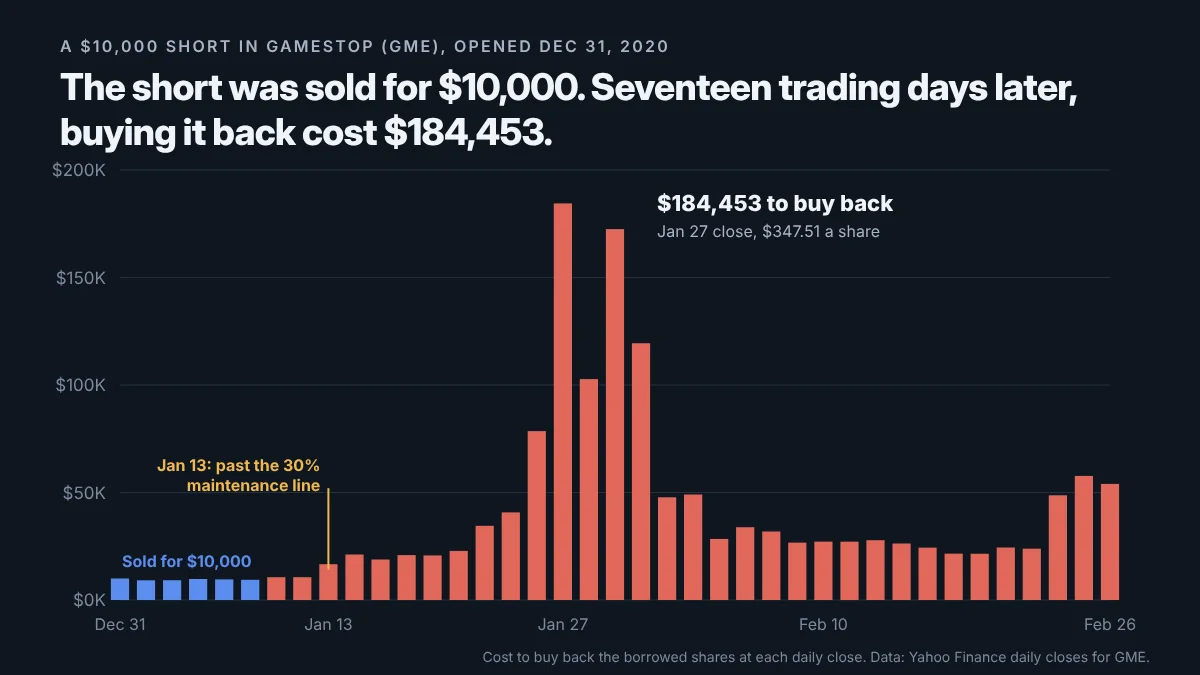
Short selling means borrowing shares from your broker, selling them right away, and buying them back later to return them, so you profit if the price falls and lose if it rises. Because a stock cannot fall below zero but can keep rising, the most a short can make is 100% of what the shares sold for, while the loss has no limit. A $10,000 short in GameStop at its December 31, 2020 close would have cost $184,453 to buy back at the January 27, 2021 close.
Most people make money in stocks the same way: they buy a share, wait, and hope to sell it later for more. Short selling flips that order around. A short seller sells first, at today's price, and buys later, hoping the price has dropped in between. The risks, however, are not a mirror image of buying, and the clearest way to see why is to look at what happened to people who were short GameStop in January 2021.
What is short selling?
The SEC's investor site, Investor.gov, puts it plainly: "A short sale occurs when you sell stock you do not own." You can only sell something you do not own by borrowing it first, so in practice your brokerage firm lends you the shares, you sell them on the market right away, and you keep the cash from the sale in your account. At some point you have to give the shares back, which means buying the same number of shares on the market and returning them to the lender. Buying them back is called covering the short.
If the price fell while you were short, you buy back the shares for less than you sold them for and keep the difference. The SEC's guide, Key Points About Regulation SHO, uses a simple example: sell borrowed shares of a company at $60, buy them back at $40, and your profit is $20 a share before commissions and fees. If the price rose instead, you have to pay more to buy the shares back than you received for them, and the difference comes out of your own money.
Being short also costs money while you wait. The same SEC guide says your broker will charge you interest on the loan, as it would on any margin loan, and that "if the stock you borrow pays a dividend, you must pay the dividend to the person or firm making the loan." A shareholder collects dividends, while a short seller pays them.
Why can a short seller lose more than they put in?
When you buy a stock, the worst that can happen is that the company goes to zero and you lose what you paid. When you short a stock, your loss depends on how high the price can go, and there is no ceiling on that. The SEC says it directly in its Regulation SHO guide: "shorting a stock leaves an investor open to the possibility of unlimited losses, since a stock can theoretically keep rising indefinitely."
The flip side is that a short seller's best possible outcome is capped. A stock cannot fall below zero, so the most a short can ever earn is 100% of what the shares were sold for, and in practice it earns less because of interest and any dividends owed along the way. Peloton shows what that looks like. The stock closed at $167.42 on January 13, 2021, and its lowest close since then was $2.88 on August 14, 2024, according to daily prices from Yahoo Finance. A $10,000 short at that January close, covered at that exact bottom, would have made about $9,828 before costs, a gain of 98.3%.
That lopsided shape is the most important thing to understand about short selling. A buyer risks 100% to make an unlimited amount, and a short seller risks an unlimited amount to make at most 100%.
What happened to GameStop short sellers in 2021?
GameStop was one of the most heavily shorted stocks in the country going into 2021. Analysts measure this with short interest, which is the number of shares that have been sold short and not yet bought back, usually shown as a percentage of the float (the shares that are available for the public to trade). In its October 2021 staff report on the meme-stock episode, the SEC found that GameStop's short interest reached 122.97% of its float in January 2021. The report explains that a figure above 100% is possible because the same shares can be lent, sold and lent again, while for large companies short interest is often below 2.5%.
GameStop closed at $18.84 on December 31, 2020, according to Yahoo Finance. (Yahoo now shows that price as $4.71 because of a four-for-one stock split in 2022, and this article uses the prices as they were quoted at the time.) Then the stock took off. It closed at $347.51 on January 27, 2021, a rise of 1,745% in seventeen trading days.
Picture someone who shorted $10,000 of GameStop at that year-end close, which meant borrowing and selling about 531 shares. Buying those same shares back at the January 27 close would have cost $184,453, for a loss of $174,453. The chart at the top of this article shows the cost of covering that short at every daily close through the end of February. Even after the stock fell back, covering on February 26 would still have cost $54,002. In practice, the investor's broker would have stepped in long before the peak, because of the margin rules.
How do margin rules apply to a short sale?
The SEC's guide notes that a short seller is subject to the margin rules, the same rules that apply to someone who buys stock with money borrowed from a broker. A margin account is a brokerage account where the firm lends you money or shares against the value of what you hold. Two sets of rules decide how much of your own money has to be in that account. The first is the Federal Reserve's Regulation T, and its margin table requires 150% of the market value of a stock sold short. For a $10,000 short, the $10,000 from the sale counts toward that, so you have to add $5,000 of your own.
The second is FINRA Rule 4210, which sets the minimum you must keep in the account after the trade, called the maintenance requirement. According to the rule's text, for a stock trading at $5 or more you must keep at least $5 a share or 30% of the short position's current value, whichever is greater, and for a stock under $5 the requirement is $2.50 a share or 100% of the value. Brokers can set stricter limits of their own.
Applied to the GameStop example, the account starts with $15,000, which is the $10,000 from the sale plus the $5,000 deposit. Your own stake is what is left after subtracting the cost of buying the shares back, so it shrinks as the stock rises. Once the cost of the shares rises 15.4%, to about $11,538, your stake falls below 30% of the position and the broker can demand more money, which is called a margin call. GameStop crossed that line at its close on January 13, 2021, only eight trading days into the year, when it ended at $31.40. If the investor cannot add cash, the broker can buy back the shares on their behalf at whatever the market price is. The loss at the peak, $174,453, was nearly 35 times the $5,000 the investor put in.
What is a short squeeze?
A short squeeze happens when a rising price forces short sellers to buy back their shares, and that buying pushes the price up even more, which forces still more short sellers to cover. Because every short position eventually has to be closed with a purchase, a stock with a very large short interest carries a lot of future buying inside it.
GameStop is usually described as the textbook squeeze, but the SEC's staff report was more careful than that. It found that some sharp jumps in the price happened at the same time that large short sellers were covering, yet it also found that this buying "was a small fraction of overall buy volume." The report concluded that "a short squeeze did not appear to be the main driver of events," and that "it was the positive sentiment, not the buying-to-cover, that sustained the weeks-long price appreciation of GameStop stock." Short sellers were up against a crowd of buyers who simply wanted the stock.
What rules limit short selling?
Short selling is legal in the United States and is governed mainly by the SEC's Regulation SHO. Its central requirement is the locate rule: before a broker accepts a short sale, it must have reasonable grounds to believe the shares can be borrowed and delivered on time, and it has to document that check. The SEC describes the problem this guards against as a "naked" short sale, where the seller does not borrow or arrange to borrow the shares in time to deliver them to the buyer.
Regulation SHO also includes a circuit breaker. In 2010 the SEC adopted Rule 201, and according to the SEC's guide it kicks in when a stock falls at least 10% in one day. For the rest of that day and the whole of the next one, short sales in the stock are held to a price test, which limits the prices at which they can be made. The SEC says the rule is meant to keep short selling from driving down even further the price of a stock that has already dropped sharply, and to let investors who own the shares sell first.
Regulators have occasionally gone further. On September 19, 2008, during the financial crisis, the SEC, acting together with the U.K. Financial Services Authority, temporarily banned short selling in the shares of 799 financial companies, with the order initially set to end on October 2. The SEC still noted that "under normal market conditions, short selling contributes to price efficiency and adds liquidity to the markets."
Why are the long-run odds against short sellers?
Beyond the lopsided payoff, a short seller is betting against the market's general direction over time. Using daily closing prices for the S&P 500 index from Yahoo Finance going back to January 1950, the table below shows how often the index was higher after different holding periods.
| Holding period | How often the S&P 500 was higher |
|---|---|
| One trading day | 53.1% of days |
| One year (252 trading days) | 74.7% of starting days |
| Five years (1,260 trading days) | 84.2% of starting days |
| Calendar year, 1951 to 2025 | 55 of 75 years |
S&P 500 price index, daily closes from January 3, 1950 to November 2, 2026, from Yahoo Finance. Dividends are not included, so the index's total return was higher than shown.
The longer the holding period, the more the odds tilted toward higher prices. A short position on the overall market would have lost money over about three out of every four one-year stretches since 1950, before counting the dividends a short has to pay. Plenty of individual stocks do fall for good, but that upward drift is something every short seller works against.
How can StockChat help you size up a stock's swings?
To judge risk on either side of a trade, you need a sense of how far a stock normally moves. StockChat's Analysis feature answers questions like "How big are GME's ups and downs?" and "How bad have the drops been?" for any stock, in plain English, using the stock's own price history, so you can see whether a move is ordinary for that company or unusual.
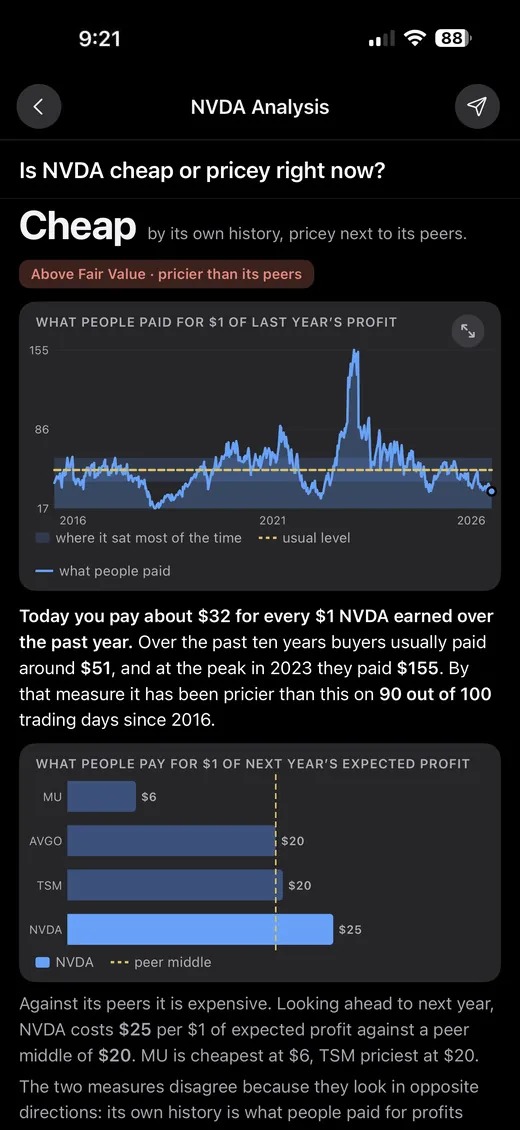
StockChat is a private group chat with the research built in. When someone in your group brings up a heavily shorted stock, everyone can open the same answers about how much it usually moves and how deep its past drops have been.
Join the free betaWhat should a beginner take away?
Short selling is a legal and useful part of how markets work, but for an individual investor it works very differently from buying. The gain is capped at the price you sold for, the loss has no cap, you pay interest and any dividends for as long as you hold the position, and a fast rise can trigger a margin call that forces you out at the worst possible moment.
If you see a stock described as heavily shorted, remember both halves of the GameStop story: short sellers can lose badly on a fast rise even if they later turn out to be right about the business, and a rise that starts with short covering can keep going for reasons that have nothing to do with them.
Frequently asked questions
Is short selling legal?
Yes. Short selling is legal in the United States and is governed mainly by the SEC's Regulation SHO, which requires brokers to confirm that the shares can be borrowed before a short sale. The SEC did temporarily ban short sales in 799 financial stocks in September 2008.
How much can you lose short selling a stock?
There is no fixed limit, because a stock's price can keep rising. A $10,000 short in GameStop opened on December 31, 2020 would have lost $174,453 by the January 27, 2021 close, nearly 35 times the $5,000 deposit Regulation T requires.
What is a short squeeze?
A short squeeze is a rise in price that forces short sellers to buy back shares, and their buying pushes the price higher still. The SEC's 2021 staff report found that short covering was a small part of GameStop's buying and that positive sentiment sustained the rise.
Do short sellers have to pay dividends?
Yes. If the borrowed stock pays a dividend while you are short, you must pay that amount to the lender, and your broker also charges interest on the loan.
Oscar is the founder of StockChat, where he writes plain-English guides that explain how the market works and where the numbers behind it come from. LinkedIn
This article is educational and is not financial advice.
 What is a stock split, and does it make a stock cheaper?
 Limit Order vs. Market Order: What's the Difference?
 Fundamental analysis: how to read a company's numbers, with ten years of real data