 StockChat
What is EPS (earnings per share), and why can it grow faster than profit?
Earnings per share tells you how much of a company's profit belongs to each share you own. This guide shows how it is calculated with Apple's real numbers, why buybacks helped Apple's EPS more than triple while its profit doubled, and what it means when EPS turns negative.

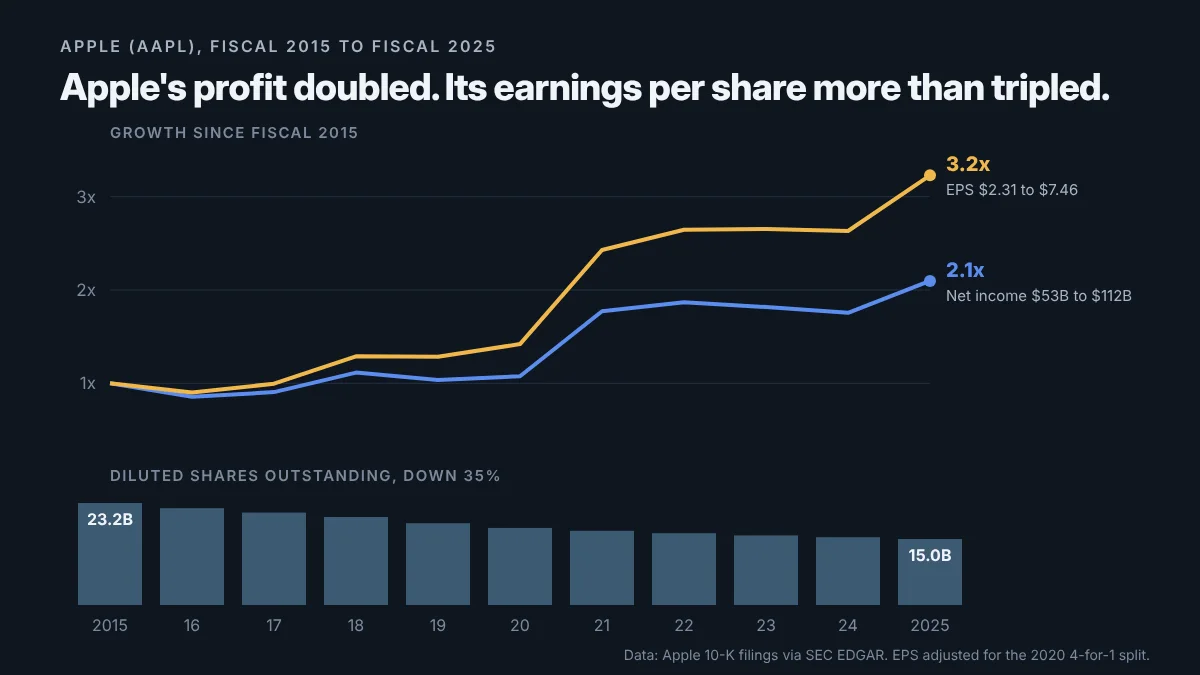
Earnings per share, or EPS, is a company's net income divided by its average number of shares. Apple earned $112.0 billion in fiscal 2025 on about 15.0 billion diluted shares, for an EPS of $7.46. Because the share count is part of the math, a company that buys back its own stock can grow EPS faster than its profit, which is how Apple's EPS rose about 3.2 times from fiscal 2015 to 2025 while its net income rose about 2.1 times.
Every time a public company reports its results, the number that shows up first in the headlines is usually not its total profit but its earnings per share, almost always shortened to EPS. It is the figure analysts forecast, the one a company is said to "beat" or "miss," and the bottom half of the price-to-earnings ratio that most investors use to judge whether a stock looks cheap. Understanding where it comes from, and what can move it besides profit, makes a lot of financial news much easier to read.
What is earnings per share?
Earnings per share is a company's net income, meaning the profit left over after every expense, interest payment and tax, divided by the number of shares it has outstanding. It answers a simple question: if you split the company's profit for the year evenly across every share, how much would land on each one? A company that earns $1 billion and has 500 million shares has an EPS of $2, and if you owned 100 of those shares, your slice of that year's profit would be $200, whether or not the company actually paid any of it out to you.
Apple is a good real example because its numbers are so large. In its annual report for fiscal 2025, the year that ended on September 27, 2025, Apple reported net income of $112.0 billion. Over that year it had, on average, about 15.0 billion shares outstanding once you count the extra shares that employee stock awards could turn into, so its diluted earnings per share came to $7.46. Owning one Apple share for that year meant owning $7.46 of its profit.
Notice that the share count is an average for the year rather than the number on the last day. Companies issue and retire shares all the time, so accountants use a weighted average, which counts a share that existed for half the year as half a share. That keeps a buyback in December from making the whole year's EPS look better than it was.
What is the difference between basic and diluted EPS?
Companies report two versions of EPS, and the difference comes down to which shares are counted. Basic EPS divides profit by the shares that actually exist. Diluted EPS also counts shares that could exist soon, such as stock options and restricted stock granted to employees or bonds that can be converted into stock, because those claims would split the same profit among more owners if they were turned into shares.
For Apple the gap is small. Its basic EPS for fiscal 2025 was $7.49 on about 14.95 billion shares, and its diluted EPS was $7.46 on about 15.00 billion. At younger companies that pay employees heavily in stock, the gap can be much wider. When a news story or a stock app quotes "EPS" without saying which kind, it almost always means diluted EPS, and that is the more conservative number to use.
How can EPS grow faster than profit?
Because the share count sits at the bottom of the fraction, earnings per share can rise even in a year when total profit does not, as long as the number of shares falls. Companies shrink their share count by buying back their own stock, and Apple has done that on an enormous scale. The chart at the top of this article follows Apple from fiscal 2015 to fiscal 2025, using figures from its annual reports and adjusting the older per-share numbers for the four-for-one stock split Apple carried out in 2020.
Over those ten years Apple's net income grew from $53.4 billion to $112.0 billion, an increase of about 2.1 times. Over the same stretch its diluted share count fell from about 23.2 billion to about 15.0 billion, a decline of 35%, so each remaining share owned a bigger slice of a bigger profit. The result is that EPS rose from $2.31 to $7.46, an increase of about 3.2 times. Someone who held Apple through that decade saw their share of the profit grow considerably faster than the company's profit did.
The reverse happens at companies that issue a lot of new stock. Palantir became profitable in 2023, and from 2023 to 2025 its net income grew from $210 million to $1.63 billion, but its diluted share count rose by about 12% over those two years, largely because of stock paid to employees. Its EPS still grew a great deal, from $0.09 to $0.63, but by less than its profit. The table below compares the two numbers for several large companies over the most recent five fiscal years each one has reported.
| Company | Years | Profit | EPS |
|---|---|---|---|
| Apple (AAPL) | FY20 to FY25 | +95% | +127% |
| Microsoft (MSFT) | FY21 to FY26 | +118% | +123% |
| Alphabet (GOOGL) | FY20 to FY25 | +228% | +269% |
| Meta (META) | FY20 to FY25 | +107% | +133% |
| Tesla (TSLA) | FY20 to FY25 | +426% | +414% |
| Palantir (PLTR) | FY23 to FY25 | +674% | +600% |
Profit is net income and EPS is diluted earnings per share, both shown as the change over the period. They come from each company's annual reports filed with the SEC, through EDGAR, with per-share figures adjusted for stock splits. FY20 means the company's fiscal year 2020, and Palantir is shown from 2023, its first profitable year.
Apple, Alphabet and Meta all reduced their share counts over the period, which is why their EPS outran their profit. Tesla and Palantir went the other way. None of this makes one company better than another on its own, since a buyback uses cash that could have been invested in the business, but it does mean that EPS growth and profit growth are two different measurements, and the gap between them tells you whether the company is shrinking or expanding the number of slices.
How does EPS connect to the P/E ratio?
The price-to-earnings ratio is simply the share price divided by earnings per share, which turns EPS into a way of asking how much buyers are paying for each dollar of profit. Microsoft reported diluted EPS of $17.95 for its fiscal year that ended on June 30, 2026, and its shares closed at $530.14 on October 29, 2026, according to Yahoo Finance. Dividing one by the other gives a P/E of about 29.5, meaning buyers were paying roughly $29.50 for every dollar Microsoft earned per share in that fiscal year.
That is also why EPS, rather than total profit, is the right number to compare with a share price. A company's total profit tells you nothing about what one share is worth unless you know how many shares there are, while EPS and the share price are both measured per share, so dividing one by the other compares like with like. The same logic explains why a stock split does not change a company's P/E: the split cuts the price and the EPS by the same proportion.
What does negative EPS mean?
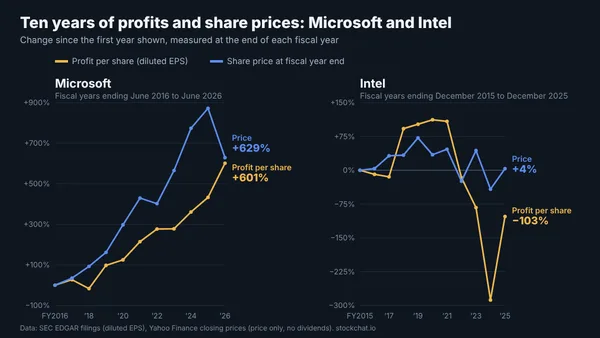
When a company loses money, its EPS is negative, and the P/E ratio stops being meaningful because there are no earnings to divide by. Intel is a clear recent example. Its diluted EPS was close to $5 a year from 2019 through 2021, then fell sharply as its business struggled, and in 2024 the company lost $18.8 billion, which works out to a loss of $4.38 per share.
Intel's 2024 results are also a good illustration of the difference between GAAP and adjusted EPS. GAAP stands for generally accepted accounting principles, the standard rules that every American public company has to follow in its official statements. Many companies also publish an "adjusted" or "non-GAAP" figure that leaves out costs they consider unusual, such as restructuring charges, write-downs of assets and stock-based pay. In its results release for the fourth quarter of 2024, Intel reported full-year GAAP EPS of negative $4.38 and non-GAAP EPS of negative $0.13, a difference of more than $4 per share.
Adjusted numbers are not dishonest, and the SEC's Regulation G requires any company that publishes one to show the matching GAAP figure alongside it and to reconcile the two. But the costs a company leaves out still cost real money, so when the adjusted number looks much better than the GAAP one, it is worth reading the reconciliation table to see what was removed.
What does it mean when a company beats or misses on EPS?
Before each quarterly report, analysts at banks and research firms publish their own forecasts of the company's EPS, and the average of those forecasts is called the consensus estimate. When the company reports, the headline compares its actual EPS with that estimate, and a result above it is called a beat while a result below it is called a miss. Most of these comparisons use the adjusted figure, because that is what analysts usually forecast.
A beat does not guarantee that the stock will rise. The share price already reflects what investors expected, and the market often reacts more to the company's forecast for the coming quarters than to the quarter that just ended. That is why it is common to see a company beat its EPS estimate and still fall the next day, or miss and still rise.
How does StockChat use earnings per share?
StockChat's Analysis feature builds several of its plain-English answers on a company's earnings per share. The question "Is it cheap or pricey right now?" compares what buyers are paying for each dollar of profit per share today with what they usually paid over the past decade and with the company's peers, and the question "Does it usually rise or fall on earnings day?" shows how often the company has beaten or missed analysts' estimates and how its share price moved after each report.
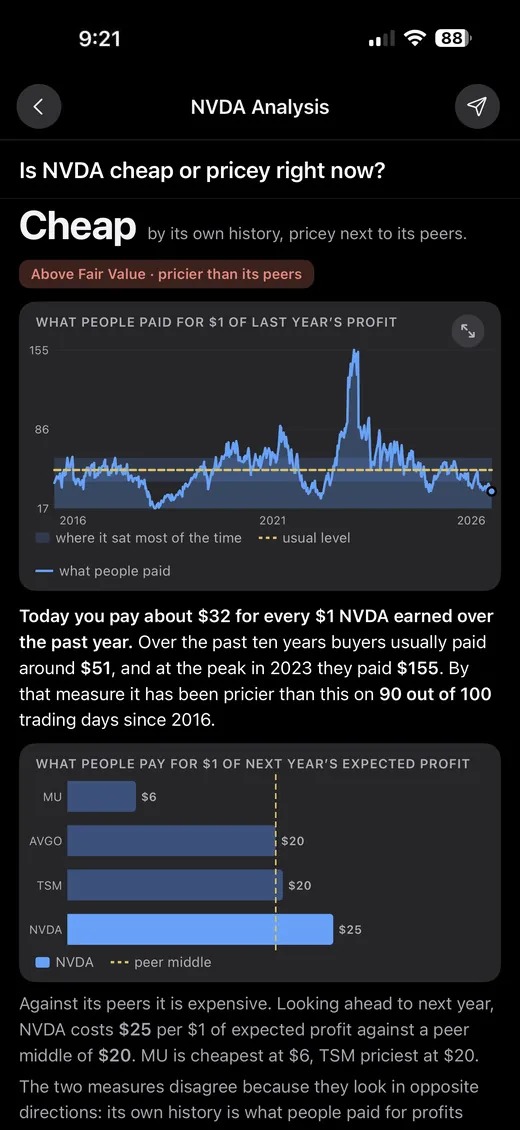
StockChat is a private group chat with the research built in. When earnings come out and someone in your group asks whether the company beat, everyone can open the same answers about its profit per share, what buyers are paying for it, and how the stock has reacted to past reports.
Join the free betaHow should a beginner use EPS?
The most useful way to read EPS is as a trend rather than a single number. One year's EPS can be distorted by a one-time charge, a tax change or a large sale of assets, but five or ten years of diluted EPS show whether the profit that belongs to each share is actually growing. It also helps to put EPS next to net income, as the table above does, because the gap between them shows whether buybacks or new share issuance are doing part of the work.
EPS on its own also says nothing about price. A company with an EPS of $10 is not necessarily a better business than one with an EPS of $1, since the first might have far fewer shares, and an EPS figure only becomes useful for judging a stock once you compare it with the share price, which is exactly what the P/E ratio does. Treat it as one of the most important numbers in an earnings report, but as the start of the question rather than the answer.
Frequently asked questions
How do you calculate earnings per share?
Divide the company's net income for the period by its weighted average number of shares outstanding. Apple's net income of $112.0 billion in fiscal 2025, divided by about 15.0 billion diluted shares, gives an EPS of $7.46.
What is the difference between basic and diluted EPS?
Basic EPS counts only the shares that exist. Diluted EPS also counts shares that stock options, employee stock awards and convertible bonds could create, so it is a little lower. Apple's basic EPS for fiscal 2025 was $7.49 and its diluted EPS was $7.46.
Is a higher EPS always better?
Not on its own. EPS depends on how many shares a company has, so a $10 EPS is not better than a $1 EPS at a company with ten times as many shares. EPS growth over several years, and EPS compared with the share price through the P/E ratio, are more useful.
What does negative EPS mean?
It means the company lost money over the period. Intel lost $18.8 billion in 2024, a loss of $4.38 per share, and a stock with negative EPS has no meaningful P/E ratio.
Oscar is the founder of StockChat, where he writes plain-English guides that explain how the market works and where the numbers behind it come from. LinkedIn
This article is educational and is not financial advice.
 Fundamental analysis: how to read a company's numbers, with ten years of real data
 What is the P/E ratio, and what counts as a good one?
 What is dividend yield, and when is a high one a warning?